Event 1
Death of Joe Burkett in Central Park
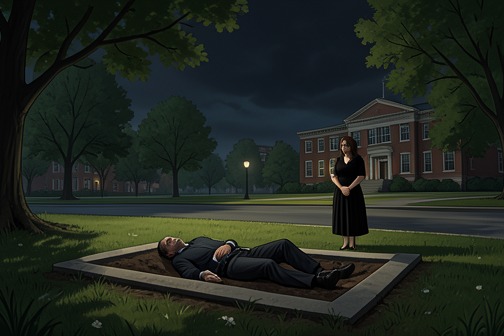
The [Death of Joe Burkett in Central Park](entity:event-recall-event-joe-burkett-3dcd32ab5db6) is the defining loss around which [Maya Stern](entity:character-recall-character-maya-stern-a52f3b60bd3f)’s account of the attack, her flight, and the aftermath turns. The murder is first approached through the rituals of burial, then through recollections that return in fragments: the glint of metal, gunfire, Joe falling, and Maya running into the dark.
## The Attack and Its Immediate Aftermath
Joe was buried three days after his murder. At the funeral, Maya wore black and faced the service with a soldier’s rigid bearing, while the pastor’s familiar condolences failed to hold her attention. Her gaze drifted instead to the elementary school across the street from the cemetery. The burial placed an ordinary scene of childhood beside the fact of Joe’s death, but Maya’s attention remained partly elsewhere, drawn back toward the violence she had survived.
In her later account to [Roger Kierce](entity:character-recall-character-roger-kierce-a9ce6f9cf78c), Maya described two men approaching from the west. She confirmed that one of them fired at Joe. The first bullet struck his left shoulder; the second hit the right side of his clavicle. Maya recalled Joe dropping to his knees, but she could not say that she saw the third shot. By then, she was running away.
The distinction between what Maya witnessed and what she learned afterward defines her account of the killing. She said that she fled because the two men had guns. Five or ten seconds later, she heard a blast from behind her. Based on what Kierce told her, she understood that after she ran, the gunman pressed the weapon to Joe’s head while he was still on his knees and fired. Her memory therefore holds the attack in two parts: the shots she saw, and the final shot she heard only after leaving Joe behind.
## The Burial and the Return of the Attack
At the funeral, the violence returns not as a complete account but as an involuntary flash: the casket’s descent gives way to the park, and the funeral’s present is interrupted by the remembered murder. Maya Stern has learned to endure funerals by going numb, letting sights and sounds blur. Yet the thud of [Joe Burkett](entity:character-recall-character-joe-burkett-ff87ad74dc0f)’s casket reaching the bottom briefly breaks through that practiced distance. [Judith Burkett](entity:character-recall-character-judith-burkett-f47ac3a24d33) sways against her, while Maya holds herself upright in a soldier’s posture, using discipline both to steady herself and to appear steady.
The same division between composure and intrusion surfaces when Roger Kierce questions Maya Stern. As she tries to answer, the sounds of gunfire, helicopter rotors, and screams rush back together; her chest hitches, and she closes her eyes and takes several breaths before continuing. The memory does not arrive as a neatly ordered story. Its sensory fragments threaten to overwhelm her precisely when she is being asked to give an orderly account of what happened.
Maya Stern’s silence about the final shot is therefore more than a gap in the sequence of evidence: it marks the boundary between witnessing and reconstructing. She remembers Joe Burkett falling, but the last shot is outside her sight; she learns its manner from what Kierce tells her and connects it to the blast she heard while fleeing. The scene’s painful uncertainty is not resolved by making her a witness to every moment. Instead, the account preserves the difference between what she saw, what she heard, and what she later understood.
## The Body as Proof of Death
[Caroline Burkett](entity:character-recall-character-caroline-burkett-8ecd81c1903e) turns the question of Joe’s death toward an absence that had shaped her own grief. She asks Maya why soldiers insist on bringing their dead home when nothing more can be done for them. Maya answers from military duty: no one is left behind. Caroline suggests that the body matters most to the family, whose need to see the deceased can make death real and permit a measure of closure.
Caroline explains why that distinction matters to her. After [Andrew Burkett](entity:character-recall-character-andrew-burkett-608b4457561b) died in an accident, his family did not show her his body; the casket was closed. Even years later, she dreams that Andrew survived, sees him by the soccer net making saves, and sometimes imagines that he swam away and is living on an island. She knows he died, yet without having seen his body she has never fully accepted the loss. Her account makes the physical evidence of death more than a funeral detail: it is what might have kept grief from turning into a continuing possibility of return.
That history explains Caroline’s insistence that Maya see Joe’s body. Maya says she asked and begged, willing even to face how badly he might have been injured, because she needed to accept that he was gone. She was not allowed to see him. The contrast is stark: Caroline’s experience taught her what an unseen body can leave unresolved, while Maya’s attempt to avoid repeating that experience could not secure the confirmation she sought. Joe’s burial therefore does not, by itself, provide the certainty or farewell that the ritual appears to promise.
## The Loss and Its Continuing Presence
Joe Burkett’s death remains present in the novel’s final movement not as a newly clarified account of the killing, but as a loss carried into another generation. [Shane](entity:character-recall-character-shane-05621ac800e8) stays close to [Lily](entity:character-recall-character-lily-96089ba009e2) because he loves her, and because her resemblance to Maya Stern lets him feel that some connection to Maya survives. Lily’s smile recalls her mother’s, though Shane remembers rarely seeing Maya smile so openly. The resemblance offers comfort without undoing the death: Lily does not remember her mother, while Shane’s memories of Maya remain active in ordinary imagined moments, including the impulse to tell her how Lily is doing.
The closing reflection places Joe’s death within a wider uncertainty about what it means for the dead to be gone. Shane remembers that Maya treated death as final, but, looking at the newborn named Maya, he finds himself unable to hold that certainty in quite the same way. The ending does not reverse Joe’s murder or establish a literal return; instead, it lets a name, a child’s presence, and the persistence of memory complicate the boundary between absence and continued attachment. The killing that began as an abrupt rupture thus remains consequential beyond the burial: the living carry the dead forward through love, remembrance, and the identities they give to those who come after.
Event 2
Death of Claire Walker at home
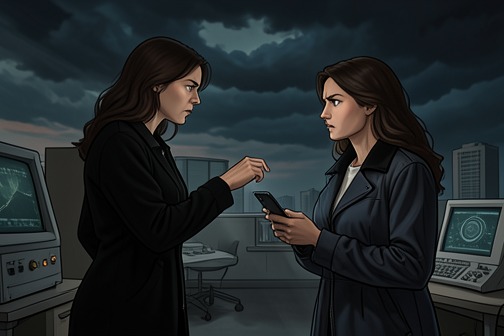
[Claire Walker](entity:character-recall-character-claire-walker-e40954ccca49)’s death at home is first presented as a possible home invasion and later exposed as part of a more troubling pattern: the same gun killed both [Claire](entity:character-recall-character-claire-a8a181f2052b) and [Joe Burkett](entity:character-recall-character-joe-burkett-ff87ad74dc0f). The revelation does not identify who killed Claire, but it collapses the distance between the sisters’ loss and [Maya Stern](entity:character-recall-character-maya-stern-a52f3b60bd3f)’s own bereavement, replacing an apparently ordinary crime with an unresolved connection between two murders.
## The First Account of Claire’s Death
When Maya discusses Claire’s murder with [Eileen Finn](entity:character-recall-character-eileen-finn-eee1b1baafd6), [Eileen](entity:character-recall-character-eileen-7f2a83f06e48) recalls the account she had been given: the police thought it was a home invasion committed by drifters. The explanation is spare and provisional, framed as what investigators believed rather than as an established finding. The actual details of the killing are not laid out in this conversation; what matters is how readily the early theory appeared to contain the event. Claire had been killed at home, and the supposed intruders seemed to offer a category for the crime without explaining its deeper cause.
Maya rejects that account outright. She tells Eileen that Claire’s death was not a home invasion and that drifters were not responsible. At this point she does not name Claire’s killer or offer a complete alternative reconstruction. Instead, she gives Eileen the concrete fact that has overturned the original explanation: the gun that killed Claire also killed Joe. The difference between an initial theory and a ballistic match is crucial. The first assigns the murder to a plausible type of crime; the second ties it to another specific death.
## The Ballistic Connection
The link emerges through an investigation of the bullets recovered from Joe’s body. [Roger Kierce](entity:character-recall-character-roger-kierce-a9ce6f9cf78c) tells Maya that the .38-caliber ammunition has been checked against other cases in the police database, and confirms that the search produced a match. He then identifies the decisive result: the gun that killed Joe also killed Maya’s sister. The match establishes a connection between the murders through their weapon, not through a demonstrated identity for the killer or a fully explained motive.
The timing intensifies the disclosure. Asked when the first murder occurred, Kierce answers that it was four months earlier; the conversation then makes clear that Claire was killed before Joe. His hesitation and inability to meet Maya’s eyes accompany the transfer of the fact, but do not soften it. For Maya, the result joins the death of her husband to a murder whose earlier explanation she had understood as a home invasion. For the investigation, it makes the weapon a link across cases and forces the two deaths to be considered together.
The evidence also sharpens a distinction between what is known and what remains uncertain. The ballistics result identifies the same gun in both murders. It does not, by itself, establish who used it, why Claire was targeted, or how her killing relates to Joe’s. The event’s mystery therefore changes shape rather than ending: an assumed explanation is displaced, while the shared weapon creates a more consequential question.
## Maya’s Reassessment
Maya’s disclosure to Eileen shows the ballistic finding moving beyond the police interview and changing how she describes her sister’s death. Eileen initially repeats the account she knew; Maya corrects it and supplies the link to Joe. Eileen’s astonishment registers the force of that revision. Maya then asks for her help, making the revelation a turning point in their conversation as well as an investigative clue: the information is not simply something to absorb but a reason to enlist another person.
Claire’s murder also forms part of the pressure surrounding Maya’s effort to judge what she has seen and been told. Later, as she tries to explain the apparent sighting of Joe on the nanny camera, Maya considers whether she had imagined or hallucinated him. She weighs that possibility against her PTSD, medication, guilt over her sister’s murder, and the events in [Central Park](entity:location-recall-location-central-park-552b924273db). Claire’s death is thus not only a case to solve; it is among the losses and burdens that make Maya distrust her own interpretation of evidence. That uncertainty does not negate the ballistic match, but it places the search for facts alongside a struggle over whether her perceptions can be trusted.
## Narrative Significance
The murder’s changing explanation is presented through successive acts of correction. The police had believed Claire’s death to be a home invasion; the ballistic comparison supplies a specific connection that the first account could not contain. In parallel, Kierce corrects Maya’s earlier assumption that Joe called her before their meeting, telling her that he did not. That discrepancy concerns Joe’s death rather than Claire’s, but it contributes to the same investigative atmosphere: familiar accounts become unstable when checked against records and physical evidence.
Later revelations about the fabricated nanny-camera sighting show how Maya’s uncertainty could be deliberately exploited. Judith acknowledges that the family expected Maya to investigate and might make a mistake, while fabricated claims and planted disruptions were used to make her question her sanity. This later manipulation does not explain Claire’s killing or establish that it caused the ballistic link. It does, however, give the earlier uncertainty around Claire’s death added narrative weight: Maya is trying to distinguish genuine clues from false stories in a situation where both can be made to look plausible. The shared gun is therefore decisive not because it solves Claire’s murder, but because it turns a dismissed-sounding theory about drifters into a connection that Maya cannot ignore.
Event 3
Death of Andrew Burkett at sea
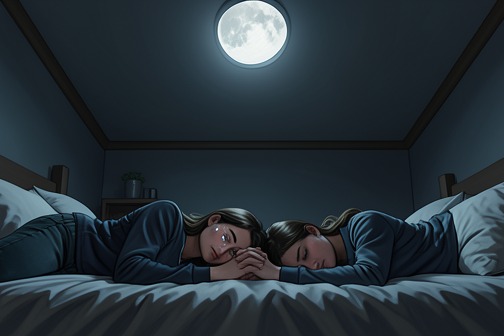
[Andrew Burkett’s death at sea](entity:action-recall-action-andrew-burkett-s-death-13c3c338d1e0) is first understood as an accident, then redefined by a secret Joe shares with Maya: Andrew jumped. That distinction transforms a family tragedy into a concealed suicide, while the absence of a body Caroline could see leaves her unable to settle the difference between what she is told and what she can accept. The event’s significance persists through grief, secrecy, and the Burketts’ later attempts to manipulate Maya’s uncertainty about death.
## The death and its concealed truth
The public account was that Andrew fell off a boat. Joe’s private account to Maya was different: Andrew jumped. Joe disclosed this during a memory Maya has of the two of them at a resort in Turks and Caicos, lying beside each other and looking at the ceiling. His eyes glistened in the moonlight; Maya took his hand as he told her what the world did not know. The scene frames the revelation not as a piece of family history delivered at a distance, but as an intimate confidence between spouses.
The distinction between falling and jumping is decisive, but the account supplies no further circumstances of Andrew’s final moments. Caroline later calls his death a suicide and says that Andrew was in so much pain that she had not seen it. Her words give the disclosed truth an emotional consequence without explaining the source or shape of his suffering. The story preserves that limit: the reader learns that Andrew chose to jump, and that his mother believes she failed to recognize his pain, but not what happened aboard the boat or what led him to that decision.
## The brothers and the family story
Caroline describes Andrew and Joe as exceptionally close. Both attended [Franklin Biddle Academy](entity:location-recall-location-franklin-biddle-acad-a0914b5bdd05), lived in the same dormitory, and played on the same soccer team. Though the family had a large house, the brothers still wanted to share a bedroom. In Caroline’s account, Joe and Andrew formed the central bond among her sons; Neil was the younger brother they tolerated. These details make Joe’s secret knowledge more than a withheld fact. He had shared formative spaces and daily life with Andrew, and he carried a version of Andrew’s death that contradicted the account known to the world.
When Caroline asks Maya whether Joe ever spoke about Andrew, Maya remembers that he did, but chooses not to disclose the secret. The omission matters: Maya is now holding part of Joe’s hidden family history while speaking with his mother, who herself describes Andrew’s death as an accident. Her silence protects Joe’s confidence, but it also leaves Caroline’s understanding untouched. The truth of Andrew’s death is therefore divided across the family: Joe told Maya; Caroline was left with the public account; and Maya must decide what, if anything, to share.
## The missing body and Caroline’s grief
Caroline says she never saw Andrew’s body. She had been told it was recovered, but she was young, and the funeral was closed-casket. She describes persistent daydreams in which Andrew is still alive, standing by a soccer net and making saves. At times she imagines that he survived the fall, swam away, and lives on an island. She recognizes that he died in an accident, yet says she cannot fully know it in the way that seeing his body might have made possible. These visions are expressions of unresolved grief, not evidence that Andrew survived.
Caroline connects this absence to her need to see Joe’s body after his death. She says she begged to see him, even if his injuries would have been difficult to look at, because she needed the sight to accept that he was gone. She was refused. Her account gives bodily presence a practical role in mourning: the body would not undo death, but it might have made death real to those left behind. The contrast is especially stark because Andrew’s suicide is the secret Joe disclosed to Maya, while Caroline’s experience of his death remains shaped by a story she was given and a body she never saw.
Caroline extends the parallel to both brothers. They died young, she says, and in neither case did she see the body. She wonders whether bad luck can account for the pattern and links it to the fact that no one will officially declare Joe dead. Her thought that both brothers might still be alive is presented as the language of grief and uncertainty, not as a factual reversal of what happened to Andrew. Maya answers that they are not alive. Caroline says she knows how her belief sounds, but the absence of physical confirmation has kept possibility open in her imagination.
## The death’s later use and significance
Andrew’s death returns later as part of a deliberate effort to unsettle Maya. Caroline had told Maya that she believed her brothers might still be alive, but Judith eventually confirms that these claims were fabrications in a psychological experiment. The manipulation combined Caroline’s lies with other destabilizing details, including the nanny camera, missing clothes, and phone calls, to make Maya question her own judgment and perhaps misstep into a confession. This revelation changes the function of Caroline’s earlier grief narrative: what appeared to be a personal account of loss had also been deployed as a calculated pressure point. It does not make her underlying history of not seeing Andrew’s body untrue; rather, it shows how genuine wounds and fabricated claims were made to work together.
The book also places Caroline’s need for bodily proof beside Maya’s military understanding that the dead must be brought home because no one is left behind. Caroline suggests that recovery matters not to the dead but to the family who must continue without them. Andrew’s unshown body gives that question intimate stakes: a death can be reported, named, and even privately understood as suicide, yet remain emotionally unfinished for someone denied the chance to see the deceased.
The ending returns to the tension between death as a fact and the bonds that survive it. [Shane](entity:character-recall-character-shane-05621ac800e8) sees [Lily](entity:character-recall-character-lily-96089ba009e2) smile with her mother’s expression, and later reflects that he is no longer certain that death is simply final. That closing uncertainty does not establish that Andrew lived; instead, it echoes the book’s concern with how memory keeps the dead present. Andrew’s death remains real, but its concealed cause, absent body, and persistence in Caroline’s imagination make it a continuing force in the lives of those who lost him.
Event 4
Al Qa'im rescue mission and video leak controversy
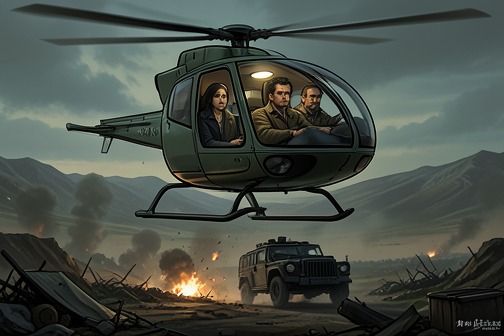
The [Al Qa'im rescue mission and video leak controversy](entity:event-recall-event-al-qa-im-a3e4e6553191) is the pivotal combat event behind [Maya Stern](entity:character-recall-character-maya-stern-a52f3b60bd3f)’s public disgrace and recurring flashbacks. What first appeared to be a rescue carried out under pressure was later exposed as a deliberate strike made without authorization, after a warning that the target might include civilians. The operation saved two soldiers, but Maya’s choice to prioritize them over the possible civilians in the black SUV left a truth more troubling than the public account: she said she did not regret the deaths, and knew she would make the same choice again.
## Mission and Immediate Crisis
Four soldiers, including three whom Maya knew and loved, had been killed in an ambush at [Al Qa'im](entity:location-recall-location-al-qa-im-f3e50c8e76a4), near the Syrian-Iraqi border. Two others remained alive, pinned down under enemy fire as a black SUV moved toward them. Maya and [Shane](entity:character-recall-character-shane-05621ac800e8) were flying at full speed in a Boeing MH-6 Little Bird light helicopter gunship when they heard the surviving soldiers’ terrified calls for help. Maya remembered how young they sounded, and knew the four already dead would have sounded the same.
The crew had to identify the approaching vehicle and wait for confirmation before engaging. The radio connection with Joint Operations Command at Al Asad kept cutting in and out. The soldiers’ pleas, by contrast, came through clearly. Maya and Shane cursed over the radio and demanded a reply from command while the two men continued to call for help. Then they heard the soldiers scream. In the account initially available to the reader, the silence from command and the urgency of the distress calls make the delay feel like a narrowing window for rescue.
Maya fired an AGM-114 Hellfire missile at the black SUV. It exploded high into the air, and infantry moved in to retrieve the two pinned-down soldiers. Both had been hit, but both survived. At the time, Maya regarded the action as righteous: its immediate, visible result was that the men calling for help lived. That outcome did not, however, establish that the target had been correctly identified or that the strike had been approved.
## What the Leak Made Public
The mission became part of the material published by [Corey Rudzinski](entity:character-recall-character-corey-rudzinski-b9d8ede4aa54)’s whistle-blower website, [CoreyTheWhistle](entity:organization-recall-organization-coreythewhistle-fcdd12f02942). The site presented leaked information about wrongdoing by governments and powerful businesses, and the combat footage brought Maya’s action into that public record. Its headline cast the incident as civilian deaths caused by an overzealous female Army helicopter pilot. The video did not merely circulate an account of a successful rescue; it linked Maya’s decision to the deaths of civilians and made her combat actions a public controversy.
The leak also changed the course Maya had imagined for herself. She had begun flying UH-60 Black Hawks at Fort Campbell, then logged enough flight time to apply to the prestigious [160th Special Operations Aviation Regiment](entity:organization-recall-organization-160-056d260012f3) in the Middle East. She had expected to remain in the Army, probably for life. After the video appeared on CoreyTheWhistle, she understood that plan to be finished. The disclosure turned an operation she had once judged righteous into the event associated with the collapse of her military future.
## The Withheld Authorization
Much later, Maya corrected the account that had allowed her and Shane to think they had followed procedure. She told him that Joint Operations Command had never given them clearance to fire. Command had radioed them to hold off because at least one person in the SUV might be a civilian, possibly underage; the assessment was that there was only about a fifty-fifty chance the occupants were enemy fighters. Maya also said she had turned off Shane’s signal. When he insisted that he had heard the authorization, she challenged that memory and reminded him that she had relayed the information to him.
The revelation recast the operation’s central choice. The uncertainty was not simply a broken line between a waiting aircraft and an unresponsive command post: command had sent a warning, and Maya had prevented that signal from reaching Shane. Her own explanation was blunt. She had not cared about the civilians; she cared about the soldiers on the ground. She made the choice to prevent another of their people from dying, accepting civilian deaths as collateral damage. The rescue was real, and so was the danger to the trapped soldiers, but neither fact erased the unauthorized decision or the lives lost in the strike.
## Flashbacks and the Meaning of Responsibility
Maya’s account of her symptoms rejects the assumption that her flashbacks are straightforward remorse for the dead civilians. A clinician distinguishes the episodes from hallucinations, describing them as vivid flashbacks associated with PTSD; they are auditory, and Maya does not see the dead soldiers, the mother, or the child. She returns in sound to the helicopter and to the moment of the mission, rather than being haunted by faces. The distinction keeps the event’s psychological aftermath tied to its unresolved decision, not to a simple confession of guilt.
Maya tells Shane that the civilian deaths do not haunt her because she feels guilty; what stays with her is knowing she would do the same thing again. Each night she relives the operation but cannot change its outcome, and she keeps trying to find a way to save the soldiers. Shane recognizes the other side of that repetition: each return also means killing the civilians again. The flashback therefore holds two consequences together—the survivors Maya saved and the people killed by her choice—without allowing either to cancel the other.
The later narration preserves uncertainty about Maya’s claim that she felt no remorse. The narrator notes that her nightly flashbacks seem difficult to reconcile with an absence of guilt, but does not resolve the contradiction. Instead, the mission remains the source of voices she could not silence after returning from [Iraq](entity:location-recall-location-7cb5e3b1d5ce). Its importance lies not only in the leak or the end of her Army plans, but in the way the same action can be remembered as rescue, violation of command, civilian killing, and a decision Maya believed she would repeat.
Event 5
Man resembling Joe appears in surveillance footage
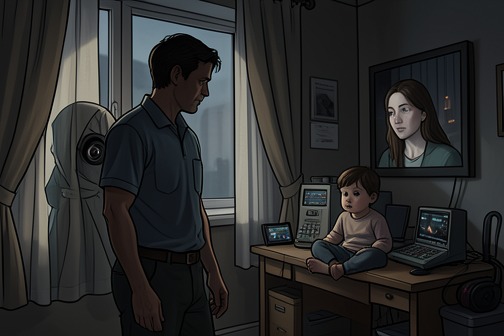
The event in which a man resembling [Joe Burkett](entity:character-recall-character-joe-burkett-ff87ad74dc0f) appears in surveillance footage transforms a nanny camera from a domestic safeguard into apparent evidence that a dead man has returned. Maya watches the recording as [Lily](entity:character-recall-character-lily-96089ba009e2) sits beside the figure in Joe’s familiar clothes, and the image overwhelms her certainty that Joe is gone. The later explanation reverses the scene: the recording was staged, the footage altered, and the SD card removed. What Maya sees is not Joe’s return but a convincing construction made possible by the gap between an image and the truth it seems to guarantee.
## The Frame and the First Clues
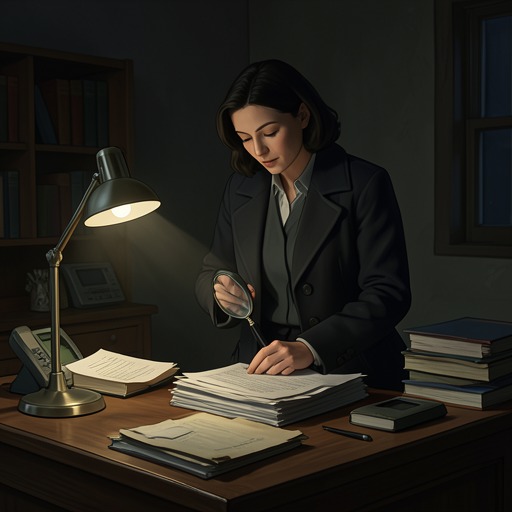
[Eileen Finn](entity:character-recall-character-eileen-finn-eee1b1baafd6) gives Maya a digital picture frame that is, in fact, a nanny camera disguised as one. The ordinary-looking object allows Maya to watch the home, but its unremarkable appearance also conceals how much the device can reveal—and how readily its images can become consequential. When Maya reviews the footage, the camera has turned itself on again, though the view is blocked by someone standing in front of it.
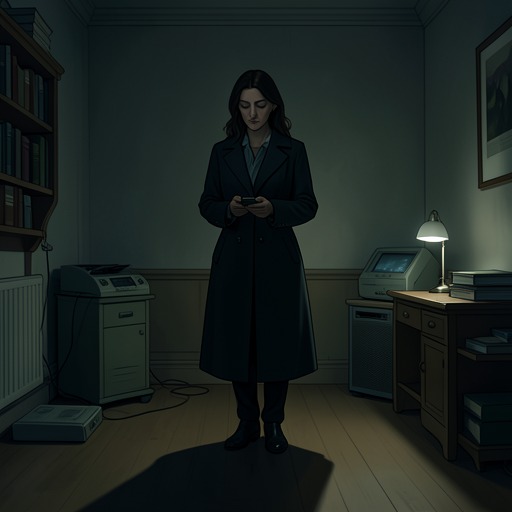
At first Maya considers whether [Isabella](entity:character-recall-character-isabella-7de94f8c52ed) is obscuring the lens. That possibility fails against the details on screen: Isabella had worn a red blouse the previous day, while the blocked view is green. The person moves away, revealing Lily alone on the couch, paging through a Dr. Seuss book and pretending to read. Someone then enters from the kitchen. The recording offers no immediate identification, only a familiar color and the unnerving fact that the person is inside the home with Maya’s child.
## The Figure Beside Lily
The man wears blue jeans and Joe’s forest green shirt, a combination Maya recognizes as specifically associated with her husband. Lily looks up and smiles broadly at him. Maya knows that Lily is not usually comfortable with strangers, so the child’s ease becomes evidence in her mind that the visitor is someone she knows. The recording’s most persuasive detail is not a clear explanation of who the man is, but Lily’s unguarded response to him.
The figure moves toward the couch and briefly blocks Maya’s view of Lily. Although Maya knows she is watching something that has already happened, not a live feed, she leans to see around him and feels panic while her daughter is out of sight. She also knows Lily is physically beside her, safe in the present. The distinction does not stop the recording from producing an immediate sense of danger: the past image seems to place Lily at risk again.
When the man turns toward the camera and sits beside Lily, Maya sees his face. Lily crawls onto the lap of her dead husband. Maya does not scream, but her body registers the shock in a spreading tightness, coldness, and trembling. The recording is brief, yet it converts a familiar domestic scene into a direct challenge to Maya’s understanding of Joe’s death. The picture frame has not merely shown her an unexplained visitor; it has made an impossible conclusion feel visible.
## The Image as Evidence—and Its Disappearance
Maya confronts Isabella about the camera and her responsibility for Lily’s well-being. Before watching this footage, she had thought the surveillance could not do much harm. Now the question is no longer only whether Maya has the right to watch the household: the camera has shown her something she cannot reconcile with what she believes she knows about Joe.
Maya tries to show the recording to [Roger Kierce](entity:character-recall-character-roger-kierce-a9ce6f9cf78c). She turns the screen toward him, clicks play, and finds that the video will not load. The SD card is missing. Without it, she cannot produce the image she has just seen. When Kierce asks what happened, Maya tells him it was Joe; he considers whether it might have been an old tape. The possibility of an outdated recording does not resolve the mystery, and the absent card prevents Maya from establishing what the footage contains or how it came to be on the device.
The later disclosure of [Eileen](entity:character-recall-character-eileen-7f2a83f06e48)’s own camera breach makes the privacy stakes broader without explaining this particular recording. Eileen receives photographs taken inside her home from an anonymous email address and suspects her husband, Robby. She had believed that cameras using SD cards were not connected to the web; she learns that the devices can nevertheless be hacked. Her experience shows that a local storage card does not necessarily mean a private, sealed system. It does not, by itself, prove that anyone hacked Maya’s camera: the eventual explanation of Joe’s appearance is deliberate staging and alteration.
## How the Apparition Was Made
The later account identifies the apparent return as a deception. Someone dressed as Joe and performed in front of the nanny camera so that it would record the scene. The SD card was taken to [Farnwood](entity:location-recall-location-farnwood-12802aa31c83), where the Burkett family had hired a CGI and Photoshop specialist to work on the footage. About an hour later, the card was returned to the house and Isabella put it back in the frame. The recorded appearance therefore combined a filmed performance with digital manipulation; its apparent authenticity was constructed rather than proof that Joe had survived.
Isabella also explains how she recognized the disguised camera. The digital frame had appeared soon after the funeral, already displaying family photographs. Maya rarely kept pictures of Lily around or hung up her artwork, so the sudden presence of a loaded frame drew Isabella’s attention. The device’s disguise worked as a camera concealment, but its novelty in Maya’s home gave Isabella a clue that it was more than decoration.
This explanation changes the force of the earlier details. Lily’s smile, the familiar clothes, and the figure’s place on the couch were not independent confirmation that Joe was alive; they were elements of a scene arranged to make Maya accept that conclusion. The missing SD card was not merely a technical inconvenience. It left Maya unable to test the image before its apparent revelation could shape her judgment.
## Death, Surveillance, and the Image’s Afterlife
The recording also resonates with the importance Maya and [Caroline Burkett](entity:character-recall-character-caroline-burkett-8ecd81c1903e) attach to seeing a body. Caroline explains that Andrew’s death remained difficult to accept because his family had never been shown his body; she still imagined that he might have survived and be somewhere beyond reach. Remembering this, Maya says that she asked to see Joe’s body so she could accept that he was truly gone, but she was not allowed to see him. The camera image appears to fill that absence with the opposite of closure: instead of confirming death, it offers a version of Joe alive beside Lily. Yet an image of a familiar face cannot provide the physical confirmation Maya had sought.
The nanny camera’s role later expands from private observation to public exposure. At Farnwood, Maya arranges for a live feed to be set up after asking [Shane](entity:character-recall-character-shane-05621ac800e8) to keep watch on [Hector](entity:character-recall-character-hector-45b791ca99c8) and Isabella. A person working with [Corey Rudzinski](entity:character-recall-character-corey-rudzinski-b9d8ede4aa54) establishes the feed, allowing people around the world to watch events in the Burkett house as they happen. Shane later describes the broadcast as a turning point for Corey’s site and for people who had been afraid to tell the truth. The concealed camera that first gave Maya a seemingly intimate image of Joe thus belongs to a larger chain of observation: recordings can be staged, withheld, and altered, but cameras can also make hidden conduct visible to a public audience. The episode’s decisive lesson is not that footage is meaningless, but that what it appears to show depends on who made it, who controls it, and whether its history can be verified.
Event 6
Isabella pepper-sprays Maya
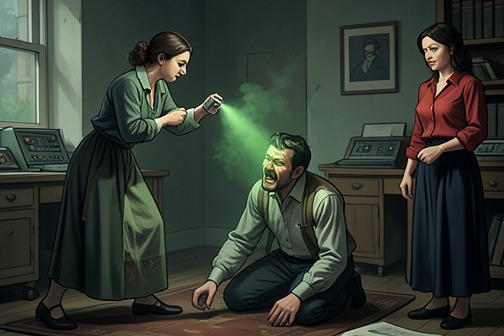
[Isabella pepper-sprays Maya](entity:event-recall-event-isabella-maya-d47e836b345d) during a confrontation over the nanny-camera footage, turning Maya’s search for answers into an abrupt physical attack. The episode leaves Maya incapacitated and [Isabella](entity:character-recall-character-isabella-7de94f8c52ed) gone; its significance extends beyond the assault, because the missing [Nanny-camera SD card](entity:object-recall-object-sd-4be191958a28) becomes part of a larger effort to make Maya doubt what she has seen and what she can prove.
## Background and Stakes
Maya confronts Isabella because she wants answers about the video in which she believes she saw Joe with their daughter. The footage is not merely unsettling: Maya’s husband is presumed dead, and what the camera appears to show challenges that understanding. The Nanny-camera SD card is therefore both potential evidence and the means by which Maya might distinguish a real recording from a misleading image.
The exchange takes place after the camera has already unsettled Maya’s account of events. Earlier, [Roger Kierce](entity:character-recall-character-roger-kierce-a9ce6f9cf78c) points out a contradiction in Maya’s recollection of the day Joe died: she says that her husband called and suggested they meet in [Central Park](entity:location-recall-location-central-park-552b924273db), but Kierce tells her that Joe did not call. Later, the .38-caliber bullets recovered from Joe’s body are matched to another case. These investigative developments do not explain Isabella’s actions, but they establish the wider pressure around Maya: her memories, the camera footage, and the physical evidence are all being scrutinized, and none offers an uncomplicated answer.
Maya’s attention turns to [Eileen Finn](entity:character-recall-character-eileen-finn-eee1b1baafd6), who gave her the nanny camera. As Maya fills a glass for Isabella, that connection flashes into her mind. The timing makes the camera’s provenance part of the immediate confrontation: Maya is not asking about an isolated domestic disagreement, but about an object and a recording at the center of her growing suspicion.
## The Attack
Isabella has a hand at her neck and rubs it dramatically. When Maya turns toward her, Isabella raises her other palm, signaling Maya to stop. Maya nevertheless says that she wants answers. Isabella nods and asks for water first. Maya hesitates, then turns to the sink, takes down a cup, and fills it halfway.
As Maya turns back, she hears a strange hiss. The spray strikes her face; the pain becomes so intense that she screams, her knee buckles, and she falls to the floor. The narration stays close to Maya’s physical experience: she describes the sensation as though tiny shards of broken glass were being driven into her eyes. She tries to hold her breath, blink, and let her tears wash the irritant away, but she cannot move and finds no immediate relief.
Only through the pain does Maya identify what happened: Isabella has sprayed her with pepper spray. The brief request for water has created the opening for the attack. Maya is turned away at the sink when Isabella acts, and the scene’s shift is stark: Maya begins it demanding information and ends it unable to pursue the person who might have answers.
Maya hears someone running and then a door closing. Isabella is gone. The escape leaves Maya on the floor, still suffering the effects of the spray; [Lily](entity:character-recall-character-lily-96089ba009e2)’s voice follows with a call for her mother. The scene thus places the assault inside Maya’s family life as well as her investigation, without resolving either the recording’s meaning or Isabella’s reason for fleeing.
## The Missing Card and the Disputed Account
Afterward, Maya checks the camera’s USB port and discovers that the SD card is gone. She searches the island and the surrounding floor, but already believes that Isabella has taken it. When Kierce asks what is wrong, Maya tells him that Isabella must have taken the card. Her conclusion is an accusation, not a witnessed act: the attack and the discovery make Isabella’s involvement seem immediate to Maya, but the card’s removal itself is not shown.
Kierce later reports that Isabella said she felt threatened, used pepper spray, and ran. When Maya asks about the missing card, Kierce indicates that Isabella denied taking it and claimed to know nothing about it. The two accounts leave an unresolved divide between Maya’s suspicion and Isabella’s denial. Maya can point to the card’s absence and to Isabella’s flight, but those circumstances do not establish who removed it.
Maya considers pressing charges, yet recognizes how the confrontation might be represented against her. She imagines herself being seen as a gun enthusiast with a controversial military past, accusing the nanny of stealing a video of her supposedly dead husband after grabbing her by the lapels. That anticipated public version of events makes the assault consequential in a second way: Maya’s credibility and conduct may become the focus, displacing the questions that prompted her to confront Isabella.
## Place in the Larger Deception
The missing card matters because the nanny-camera sighting remains open to competing explanations. Much later, Maya considers three possibilities: someone may have manipulated the footage with image-editing software; she may have imagined or hallucinated Joe, with her post-traumatic stress disorder, medication, grief, and guilt affecting her perception; or another explanation may account for what she saw. The assault does not settle which possibility is true. Instead, the loss of the card deprives Maya of material she hopes could help resolve the uncertainty.
The eventual revelation that the Burketts staged a psychological experiment on Maya changes how the episode fits into the plot. Judith acknowledges that the family wanted Maya to react, investigate, and perhaps make a mistake that could be used to implicate her in Joe’s murder. Maya explains that the family’s false claims, the nanny camera, missing clothes, and phone calls came at her together, making her question her sanity. That later disclosure gives the camera episode a broader context of deliberate manipulation, but it does not, by itself, prove who took the card or establish Isabella’s role in every part of the scheme.
The assault’s lasting force lies in that distinction between what Maya experiences and what she can demonstrate. Pepper spray gives her immediate, undeniable pain; the missing card leaves her without the recording she wants to examine; and Isabella’s denial keeps the central evidence contested. The scene turns a demand for answers into another source of uncertainty, reinforcing the novel’s tension between perception, proof, and the deliberate use of doubt.
Event 7
Eileen uses secret footage to escape Robby's control
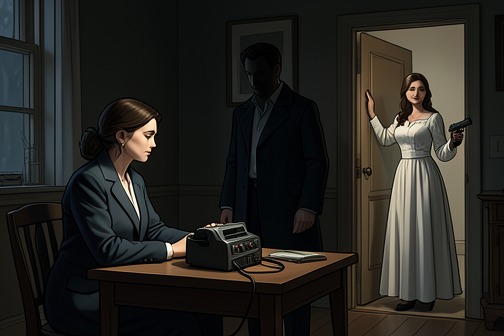
[Eileen Finn](entity:character-recall-character-eileen-finn-eee1b1baafd6)’s use of secret footage turns a private record of domestic violence into practical leverage against Robby. After he returned to abusing her, she deliberately endured and recorded another beating, then placed the tape with her lawyer. The resulting custody agreement gave her more security without resolving the danger completely: Robby knew the recording existed, and [Eileen](entity:character-recall-character-eileen-7f2a83f06e48) feared what might happen if he came back.
## Background and renewed abuse
Before the recording, [Maya Stern](entity:character-recall-character-maya-stern-a52f3b60bd3f) had already intervened when Robby threatened Eileen. After receiving Eileen’s midnight plea for help, Maya went to her home with a weapon in her purse. Robby was drunk and raging, insulting Eileen and throwing things as he searched for her; Eileen had hidden in the basement. Maya frightened him enough to stop the immediate crisis, and Eileen later thanked her for saving her life.
That intervention did not end Robby’s control. When he learned Maya had redeployed, he began coming around again. Eileen explained that she did not call the police because she expected not to be believed and knew Robby could be charming. She had also never pressed charges, caught in the cycle of fear and false optimism that kept her from taking formal action. When Robby returned and beat her, he broke two of her ribs. The injury made plain that the earlier intervention had interrupted the abuse, not ended it.
## The decision to record
Eileen considered buying a gun and wondered whether using one would count as self-defense. But she anticipated that the police might question why she had suddenly acquired a firearm and that she could still be charged. The possibility of her children, Kyle and Missy, having to understand their mother as the person who killed their father also weighed on her. A weapon seemed to promise immediate protection while threatening to leave her family with another lasting consequence.
Instead, Eileen decided to arrange one more beating and record it with a hidden camera. She understood that she would have to survive the assault, but hoped the footage might end Robby’s control without forcing her to kill him or involve her children in that outcome. The camera changed the purpose of the violence she anticipated: the recording would preserve evidence that could be shown to someone able to act on it. Her plan was dangerous and limited, but it offered a route beyond her expectation that a verbal complaint would simply be dismissed.
## The tape as leverage
Eileen brought the recording to her lawyer. He wanted to take it to the police, but she wanted the abuse to be over, so he spoke with Robby’s lawyer instead. Robby then dropped his request for joint custody. The tape remained with Eileen’s lawyer, and Robby knew it was there if he returned. Eileen did not describe this as a perfect solution; she said that things were better. Its immediate consequence was not a criminal case but a change in the terms of Robby’s access to her family.
The recording also explains why Eileen had not told Maya what she was doing. She believed there was nothing Maya could do about the situation and did not want her friend to keep acting as everyone’s protector. Her silence was not a rejection of Maya’s earlier help: she had thanked Maya for intervening. Rather, Eileen wanted Maya to be all right too, and sought to handle the next stage through evidence and a lawyer instead of another rescue. The tape made that effort possible, while the custody concession gave it a concrete result.
## Uneasy security and the camera motif
Eileen’s later fear that Robby was watching her shows how uncertain that result remained. She brought Maya photographs sent from an anonymous, untraceable email address and said she knew Robby was responsible. The images appeared to have been taken inside Eileen’s home: some showed Kyle and Missy playing on the couch, while another showed Eileen in her den after exercising. She explained that she had come home, taken off her shirt, and put it in the downstairs hamper. Her account presents the photographs as evidence of renewed intrusion, but does not establish that they came from the hidden camera used to record Robby or that the tape itself had been compromised.
Concealed cameras recur elsewhere in Eileen and Maya’s story, but their uses are not interchangeable. Eileen once gave Maya a digital picture frame that was actually a nanny camera; later, Maya’s own camera becomes part of a separate surveillance and exposure plot. Against that wider pattern, Eileen’s recording is a private, deliberately controlled piece of evidence: she chooses to document violence and entrusts the footage to her lawyer. The strategy buys a measure of safety, not certainty. Robby’s withdrawal of the custody request marks a real shift in power, while the later photographs preserve the possibility that the threat has not ended.
Event 8
Murder of Claire Walker
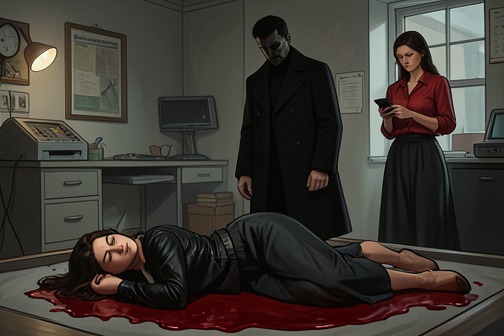
The [Murder of Claire Walker](entity:event-recall-event-murder-of-claire-walker-cb9850096737) is presented through the investigation and its aftermath rather than through a scene depicting the killing itself. Its significance sharpens as [Maya Stern](entity:character-recall-character-maya-stern-a52f3b60bd3f) connects [Claire](entity:character-recall-character-claire-a8a181f2052b)’s discovery of a supposed payoff to her murder, then learns that the same gun was used to kill [Joe Burkett](entity:character-recall-character-joe-burkett-ff87ad74dc0f). The crime is therefore both a devastating loss within Maya’s family and a clue pointing toward a larger, still-obscured connection.
## Background and the Unanswered Investigation
Maya confronts [Corey Rudzinski](entity:character-recall-character-corey-rudzinski-b9d8ede4aa54) over what he did after Claire was murdered. She asks whether he contacted the police or told them what Claire had been investigating. Corey says he did neither, explaining that he had to stay off the grid when she died. Maya rejects that softened description: Claire was not merely dead; she had been brutalized and murdered. Corey acknowledges the gravity of what happened, but his explanation does not answer Maya’s central accusation—that he failed to help find her killer.
The exchange establishes an important gap in the case. Claire had been investigating something consequential, but the police were not given that information by Corey after her death. His claim about remaining off-grid supplies a reason for his absence from ordinary channels of response, not a resolution of what Claire had uncovered or why her investigation ended in murder. Maya’s anger is directed as much at this lost opportunity to pursue evidence as at Corey’s personal failure to act.
## Claire’s Discovery and the Burkett Connection
Maya later tells [Judith Burkett](entity:character-recall-character-judith-burkett-f47ac3a24d33) that Claire found out about a supposed payoff. Judith checks that Maya means the alleged payment and receives confirmation. The pause that follows leaves the disclosure hanging between them: the payment is described as supposed, but Claire’s discovery is presented by Maya as a fact. The evidence does not specify the payment’s amount, recipient, or purpose, so its importance lies in the connection Maya draws between Claire’s investigation and the deaths that followed.
Maya places Claire’s murder beside Joe’s and reveals that the same gun killed them both. Judith reacts with disbelief, while Maya challenges her to explain why the two killings could not be connected. The exchange turns the murder from an isolated family tragedy into a possible link in a chain of events involving the Burkett family. It also reveals that [Roger Kierce](entity:character-recall-character-roger-kierce-a9ce6f9cf78c) had not told Judith about the matching-gun evidence, leaving Maya to bring the connection into their confrontation herself.
The forensic clue has a specific origin. Investigators recovered .38-caliber rounds from Joe’s body and ran them through ballistics to check whether they matched bullets in other cases. Roger Kierce tells Maya that the test found a match. The result does not, by itself, establish who used the gun in either killing or explain the motive; it does establish a concrete connection between the cases and gives Maya grounds to question whether Claire and Joe were killed separately for unrelated reasons.
## Withheld Evidence and Failed Responses
The murder’s investigation is marked by information that is missing, delayed, or held by people who might have helped. Corey did not contact police or disclose Claire’s subject of inquiry after her death. In a separate confrontation, Maya considers whether to approach Judith and [Neil Burkett](entity:character-recall-character-neil-burkett-2896b3c62022) directly about a suspected payment. She hesitates: neither is home, and she doubts that an immediate confrontation would produce a truthful answer or preserve evidence. If records had once existed, she reasons, the family could have removed or concealed them by then. Her uncertainty about what, exactly, would be covered up shows that the payment is a lead rather than a fully established explanation.
The murder also becomes entangled with an effort to manipulate Maya’s response to Joe’s death. Maya later identifies the nanny-camera footage, missing clothes, and phone calls as parts of a calculated psychological experiment. She believes the family expected her to suspect that someone was deceiving her, investigate, and perhaps make a mistake that could be used to implicate her in Joe’s murder. [Caroline Burkett](entity:character-recall-character-caroline-burkett-8ecd81c1903e) had fed her false claims about her brothers being alive and about Kierce being on the family payroll. These fabrications came alongside real grief and uncertainty, making Maya question whether her perceptions could be trusted.
That manipulation does not explain how Claire was killed, and the evidence presented here does not establish that the staged clues caused her murder. Instead, it shows how Claire’s murder and Maya’s guilt over her sister’s death could be exploited after the fact. When Maya weighs possible explanations for seeing Joe in the nanny-camera footage, she considers both digital alteration and the possibility that trauma, medication, and guilt distorted her perception. The crime thus remains an objective investigative fact even as the people around Maya work to make her doubt what she knows.
## Consequences and Narrative Significance
Claire’s murder changes the meaning of Maya’s inquiry at each return. First, it is a killing Corey failed to report or help investigate. Then it becomes connected to Claire’s discovery of a supposed payoff. Finally, the matching ballistics evidence links it to Joe’s death, while the lack of disclosure to Judith shows that even the existence of that link has been selectively withheld. Each revelation expands the case without immediately completing it: the shared weapon is evidence of connection, not a complete account of the crimes.
The event also gives Maya’s search a personal and investigative urgency that cannot be separated. Claire was her sister, and the family’s later attempt to destabilize Maya draws on her guilt about that loss. At the same time, Maya keeps testing claims against evidence: the alleged payment remains supposed, Corey’s stated reason for staying off-grid does not erase his inaction, and the ballistics match supports a connection without naming the killer. The murder’s narrative force lies in that tension between what is known and what remains concealed. Claire’s death is not merely the past that Maya mourns; it is a crime whose unanswered questions continue to shape her pursuit of the truth.
Event 9
Murder of Joe Burkett
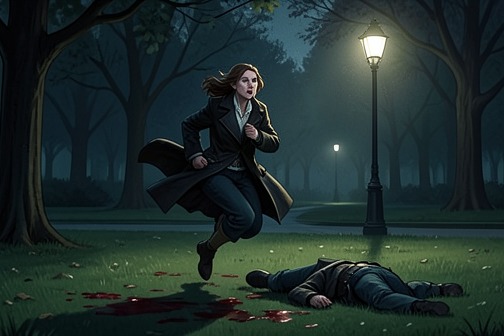
[Joe Burkett](entity:character-recall-character-joe-burkett-ff87ad74dc0f)’s murder in [Central Park](entity:location-recall-location-central-park-552b924273db) is presented through its aftermath: [Maya Stern](entity:character-recall-character-maya-stern-a52f3b60bd3f) insists that she knows he is dead because she was there, while the darkness, her flight from the scene, and the absence of a directly witnessed final moment leave room for others to doubt her certainty. The event also becomes a crucial link to [Claire Walker](entity:character-recall-character-claire-walker-e40954ccca49)’s murder when Maya reveals that both killings involved the same gun, turning Joe’s death from a private loss into evidence of a connection between the two cases.
## Circumstances and Maya’s Account
Maya’s account to [Caroline Burkett](entity:character-recall-character-caroline-burkett-8ecd81c1903e) begins in the wake of Caroline hearing about Maya’s confrontation with [Isabella](entity:character-recall-character-isabella-7de94f8c52ed). Isabella had said that Maya was screaming about seeing Joe, prompting Caroline to ask what Maya meant. Maya answers by insisting that Joe is dead and grounding that conviction in her presence at the killing: she was there.
Caroline presses on the distinction between being present and seeing a death occur. It was dark, she observes, and Maya was running away by the third shot. The exchange therefore marks a boundary in Maya’s testimony: she saw Joe fail to rise after the first two shots, but she did not remain to witness what happened at the final shot. The account supports her certainty without making her observation complete.
Maya counters Caroline’s challenge with what followed. Police came and investigated, and two suspects were arrested, she says. For Maya, those actions reinforce the conclusion that Joe died; she asks Caroline to reconcile them with the idea that he survived. The arrests function here as part of Maya’s argument, rather than as a separate account of who the suspects were or what the investigation established.
## Doubt and the Limits of Proof
Caroline’s response is not a competing explanation so much as a refusal to accept Maya’s confidence without question. She points to the darkness and Maya’s departure as reasons the moment remains uncertain to her. Maya, in turn, treats the shots, Joe’s failure to get up, and the police response as a coherent chain. Their disagreement is over what those facts can prove: Maya regards them as confirmation, while Caroline emphasizes the gap between seeing someone fall and seeing them die.
That tension gives the murder an unusual status in the conversation. Maya speaks of Joe’s death as certain, but the exchange preserves the limits of what she personally witnessed. Her assurance is built from direct presence and subsequent events, not from an uninterrupted view of the killing’s outcome. The scene does not resolve Caroline’s doubt; her shaken response leaves the difference between Maya’s knowledge and Caroline’s belief in place.
## Connection to Claire Walker’s Murder
Maya later raises Joe’s murder with [Judith Burkett](entity:character-recall-character-judith-burkett-f47ac3a24d33) while discussing the earlier killing of Claire Walker. Judith asks whether Maya is claiming that the two deaths are connected. Maya’s answer is specific: the same gun killed both of them. She recognizes that [Roger Kierce](entity:character-recall-character-roger-kierce-a9ce6f9cf78c) had not told Judith this, making the information newly consequential within their conversation.
Judith reacts with disbelief, and Maya challenges that disbelief rather than softening the claim. The revelation changes the frame around Joe’s death. It is no longer only the killing Maya witnessed or the bereavement Caroline struggles to accept; it is also a forensic link joining Joe and [Claire](entity:character-recall-character-claire-a8a181f2052b). The shared weapon supplies a concrete basis for treating the two murders as connected, even as Judith’s shock shows that this connection had not been openly established between them.
## Consequences and Narrative Significance
The two conversations present the murder from different angles. With Caroline, the pressure falls on whether Maya can be certain Joe died at all. With Judith, the pressure shifts to what the murder has in common with Claire’s death. Together, these exchanges keep the event both emotionally unsettled and investigatively active: the first tests the reliability of Maya’s account, while the second expands its significance.
The murder’s decisive force lies in that double movement. Maya’s insistence that Joe is dead confronts Caroline’s doubt, while the same-gun disclosure gives Judith a reason to reconsider the separation between Joe’s case and Claire’s. The event is thus not confined to the moment of violence. Its meaning continues to develop through testimony, police action, and evidence that links one death to another.
Event 10
Death of Andrew Burkett
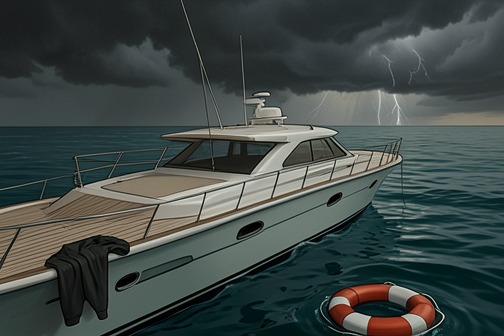
[Andrew Burkett’s death at sea](entity:action-recall-action-andrew-burkett-s-death-13c3c338d1e0) is first presented as an accident, then reopened by conflicting accounts that connect it to the earlier death of [Theo Mora](entity:character-recall-character-theo-mora-d5bf68388ed0). Andrew disappeared from the family yacht Lucky Girl during an overnight voyage, and his body was recovered the following day. The official finding was drowning after an accidental fall overboard; a later account from [Joe Burkett](entity:character-recall-character-joe-burkett-ff87ad74dc0f) called the death suicide. The novel never supplies a definitive resolution, making Andrew’s absence—and the family’s inability to settle what happened—central to the investigation that follows.
## Voyage and Disappearance
Andrew was last seen at 1:00 a.m. on October 24, after a long night of partying with family members and classmates, as he went out onto the upper deck of Lucky Girl. He was reported missing at 6:00 a.m. The yacht was travelling across the Atlantic from Savannah, Georgia, toward Hamilton, Bermuda, and had passed the midpoint between the two ports. The broad search area left the precise location of his fall unknown.
The trip brought together young Burketts, classmates, and yacht staff. Three soccer teammates from [Franklin Biddle Academy](entity:location-recall-location-franklin-biddle-acad-a0914b5bdd05) were aboard, along with Andrew’s sister, [Caroline Burkett](entity:character-recall-character-caroline-burkett-8ecd81c1903e). Joe Burkett later told [Maya Stern](entity:character-recall-character-maya-stern-a52f3b60bd3f) that he, too, had been on the boat with Andrew. Their parents, [Judith Burkett](entity:character-recall-character-judith-burkett-f47ac3a24d33) and Joseph, were not aboard; they were waiting in Bermuda with the younger Neil. Among the listed cruise staff was Rosa Mendez, who was mainly responsible for Caroline’s care. Andrew’s body was found the day after he was reported missing. News accounts identified drowning as the cause of death, but their reporting did not mention either suicide or foul play.
## Official Finding and Conflicting Accounts
[Tom Douglass](entity:character-recall-character-tom-douglass-e1df0dfa050f), who had served fourteen years in the [United States Coast Guard](entity:organization-recall-organization-united-states-co-bb57644e9f4c) before entering law enforcement, was the officer in charge of the investigation. His report classified Andrew’s death as accidental: Andrew had fallen overboard at night and drowned, with alcohol probably involved. That finding became the public explanation, and the contemporary articles Maya later found likewise described a drowning without raising suicide or foul play.
Joe gave Maya a different account. When she told [Shane](entity:character-recall-character-shane-05621ac800e8) that Andrew had not simply fallen, she explained that Joe had been present on the boat and had told her the death was not an accident: Andrew had committed suicide. This private disclosure sharply conflicts with the official report, but the evidence does not establish that Joe witnessed the fall or explain how he knew its cause. Years later, Maya put Joe’s account to Judith. Judith stiffly denied that Andrew had died by suicide, leaving the family’s version at odds with the claim Maya had received from her husband.
## A Possible Link to Theo Mora
Maya’s investigation connected the yacht death to what had happened before it. Andrew did not return to school after his death; his mother arranged for him to take the semester off. When campus life resumed, Joe led the soccer team to a successful season, including a league win and a prep-school state championship. After the season, he took teammates to celebrate aboard the family yacht. [Christopher Swain](entity:character-recall-character-christopher-swain-6afdf5d2645a), Joe’s co-captain, was among those [Neville Lockwood IV](entity:character-recall-character-neville-lockwood-iv-495e20a1f922) could identify as having been on the trip.
Lockwood proposed a theory rather than a finding. In his reconstruction, Andrew had been deeply affected by the death of his best friend, Theo Mora. He suggested that Andrew may have struggled with depression and might have been taking antidepressants or other mood-altering medication. On a yacht party, heavy drinking could have combined dangerously with medication; Andrew might then have gone to the upper deck in acute distress. Lockwood considered two possibilities: Andrew intentionally went overboard, or alcohol and medication caused him to lose his balance and fall. Either way, he argued, Theo’s death was directly connected to Andrew’s. The theory offers a possible chain of events, but neither the official report nor the evidence Maya uncovers confirms its details.
## Grief, the Missing Body, and Lasting Uncertainty
Caroline’s grief makes the difference between a reported death and an accepted death painfully concrete. She told Maya that she had been young when Andrew died and that the family had not shown her his body; his funeral was closed-casket. Although she knew he had died in an accident, she described continuing to dream that he had survived, returned to the soccer field, and was making saves. At times she imagined he had swum to an island and might one day reappear. Without seeing his body, she said, she had never been able fully to accept his death.
That experience shaped Caroline’s response when Joe died. She insisted on seeing his body, even begged to be allowed to do so, because she wanted physical proof that he was gone. She was refused. The parallel does not resolve Andrew’s cause of death, but it shows how the family’s handling of his remains left Caroline caught between knowledge and hope. In a later conversation, Maya asks why soldiers’ bodies must be brought home. Caroline’s answer is that the living need the body: the dead cannot be helped, but their families need the chance to see them and reach closure. Andrew’s absent body thus remains more than a detail in an old case; it helps explain the family’s continuing difficulty distinguishing a confirmed loss from the possibility, however implausible, of return.
The competing accounts leave Andrew’s death suspended between an official accidental drowning and Joe’s assertion of suicide. Lockwood’s proposed connection to Theo adds another layer, suggesting that the voyage may have carried the consequences of an earlier loss. None of these accounts becomes conclusive. Instead, the unresolved circumstances shape Maya’s investigation and expose how a single death can persist as both a public finding and a private wound.
Event 11
Death of Theo Mora
[Theo Mora](entity:character-recall-character-theo-mora-d5bf68388ed0)’s death, officially attributed to alcohol poisoning, is first presented as a tragic accident and then becomes the hidden link between two young men who died within weeks of each other. The circumstances of his death remain painful for his mother, [Raisa Mora](entity:character-recall-character-raisa-mora-ea51b3dc5b88), and their repeated, rehearsed-sounding explanation prompts [Maya Stern](entity:character-recall-character-maya-stern-a52f3b60bd3f) to question whether the official account tells the whole story.
## Discovery and the Official Account
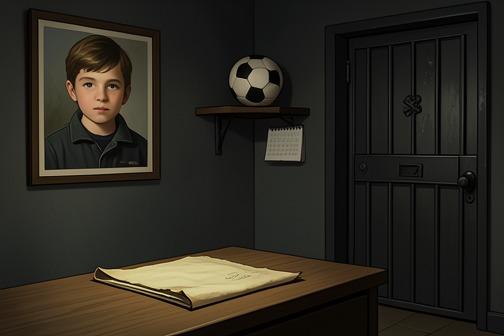
Maya first encounters Theo through a school memorial page. His portrait shows a teenage boy in a jacket and tie, his hair slicked down but beginning to spring back, wearing the awkward smile of a student posing for a school photograph. The page offers little beyond a memorial caption. Searching further, Maya finds an obituary in a [Philadelphia](entity:location-recall-location-philadelphia-375889b6054c) newspaper: Theo died on September 12, about six weeks before [Andrew Burkett](entity:character-recall-character-andrew-burkett-608b4457561b) fell from a yacht. He was seventeen. The obituary gives no cause of death, leaving the most basic explanation absent from the public record Maya can find.
A search connecting Theo’s name with Andrew’s brings Maya back to [Franklin Biddle Academy](entity:location-recall-location-franklin-biddle-acad-a0914b5bdd05), where she finds an archived soccer roster. The two boys were teammates. At this point, their deaths might still be coincidence: two students, the same age, at the same school, dead within a short span. The discovery adds a connection but does not yet explain either death. It changes the shape of Maya’s inquiry from a search for isolated tragedies into an examination of how the boys’ lives may have intersected.
[Neville Lockwood IV](entity:character-recall-character-neville-lockwood-iv-495e20a1f922) supplies the official cause: Theo died of alcohol poisoning. He describes Theo as not being known as a partier. On one night, however, Theo binge-drank, lost control of how much he had consumed, and stumbled into a basement. Neville says Theo might have been found in time to be saved, but a custodian did not discover him until the following morning. By then he was dead. The account makes the death a preventable accident whose fatal turn depended on Theo being out of sight and no one finding him overnight.
## The Link to Andrew Burkett
Maya’s questions uncover the final connection that makes the coincidence difficult to dismiss. Neville explains that Theo and Andrew were roommates. The boys were not merely students at the same elite all-boys preparatory school or members of the same soccer team: they shared a room. Both died at seventeen, and their deaths were separated by only weeks. Neville, who says he had taught statistics, treats each new connection as another factor narrowing the odds of coincidence. Roommates dying young in such close succession, he concludes, are unlikely to have no relation to one another.
That connection also gives emotional weight to what might otherwise look like a statistical pattern. Raisa recalls that Theo regarded Andrew as his best friend. After Andrew’s death, she saw Theo as deeply sad, not simply going through the motions. She knows Andrew was said to have fallen from a boat, but the timing troubles her: Theo had lost his closest friend, and then Andrew himself was reported dead in an accident. She asks Maya whether it really was an accident. Maya answers that she does not think so. That exchange does not establish how either young man died beyond the known account of Theo’s poisoning, but it makes clear that the official description of Andrew’s death is also under suspicion.
## A Repeated Story and a Mother’s Doubt
Raisa’s account of being told how Theo died closely echoes Neville’s. She says the people who informed her had recorded the conversation, apparently on a lawyer’s advice. They told her Theo had been found in the basement by a custodian, that he had drunk too much, and that he was not discovered until the next morning. Raisa remembers objecting that Theo did not drink. The explanation she received was that inexperienced drinkers can overdo it, and that a child might normally have been saved if found in time.
The near-repetition of the explanation unsettles Maya. The details are consistent with Neville’s account, but their consistency sounds practiced to her, as though the same explanation has been delivered before. The existence of a recording and the careful repetition of the circumstances establish that the account was formally documented and presented to Theo’s mother; they do not, by themselves, prove that it was false. The narrative preserves that distinction. Suspicion arises from the way the explanation is repeated and from the connections to Andrew, not from a revealed alternative cause of Theo’s death.
Raisa’s account also makes the consequences personal. Theo’s death is not simply a date in an obituary or a data point in Neville’s probability calculation. It is the loss of a seventeen-year-old whom his mother says did not drink, followed by an official explanation she remembers as difficult to reconcile with her son. Her recollection of Theo’s grief for Andrew further connects the two deaths without resolving their causes. The uncertainty belongs both to the investigation and to the family’s effort to make sense of what happened.
## Consequences and Narrative Significance
Theo’s death redirects Maya’s investigation of Andrew. The missing cause in the obituary leads her to school records; the roster establishes that Theo and Andrew played together; Neville’s disclosure that they were roommates turns proximity into a significant relationship; and Raisa’s memories reveal that they were close friends. Each piece narrows the distance between two apparently separate deaths while stopping short of a complete explanation. Theo’s death therefore functions as a clue whose force comes from accumulated connections rather than from a single definitive revelation.
The event also sharpens the story’s concern with what an official account can and cannot settle. Theo’s death has a stated cause, a location, and a reported sequence of events, yet the circumstances leave Maya and Raisa with unresolved questions. Elsewhere, Maya reflects on the importance of bringing a soldier’s body home: the dead cannot be helped, but a body can give the living a chance to accept the loss. That distinction provides a broader context for the novel’s recurring attention to death and its aftermath, without making Theo’s case equivalent to Andrew’s or establishing that Theo’s body was withheld from his family. For Maya, the official explanation and the pattern linking the boys are both evidence to weigh. Theo’s death matters because it turns grief into inquiry—and because the inquiry exposes how little certainty a repeated account can provide when the relationships around it remain unexplained.
Event 12
Al Qa'im civilian casualty incident
The [Al Qa'im civilian casualty incident](entity:event-recall-event-al-qa-im-civilian-casua-4fcedbb9968a) is both a battlefield strike and a delayed moral revelation. What first appears to be an authorized attack that saves two soldiers is later exposed as [Maya Stern](entity:character-recall-character-maya-stern-a52f3b60bd3f)’s deliberate decision to fire despite an order to hold off and uncertainty that the SUV’s occupants were combatants. The strike leaves five noncombatants dead, and its deepest consequence for Maya is not simply remorse for those deaths: it is her recognition that, given the same choice again, she would act the same way.
## The rescue mission and the strike
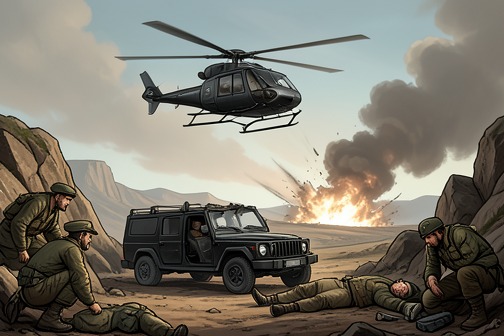
The operation began after an ambush in [Al Qa'im](entity:location-recall-location-al-qa-im-f3e50c8e76a4), near the Syrian-Iraqi border. Four soldiers had already been killed, including three whom Maya knew and loved. Two others were still alive, pinned down by enemy fire, while a black SUV moved toward them. Maya and [Shane](entity:character-recall-character-shane-05621ac800e8) were flying a Boeing MH-6 Little Bird light helicopter gunship at full speed. They could hear the survivors’ terrified calls for help, and Maya understood that the dead soldiers, too, would have sounded young and frightened.
Once the helicopter crew had the target in view, Maya and Shane waited for confirmation from Joint Operations Command at Al Asad. The radio signal kept cutting in and out. The survivors’ calls, by contrast, came through clearly; the two pilots heard them scream while they were still demanding a reply from command. Maya then fired an AGM-114 Hellfire missile at the SUV. It exploded high into the air, and infantry moved in to reach the soldiers. Both had been hit, but both survived.
At the time, Maya experienced the action as righteous: the strike appeared to answer an immediate plea for help and prevent the deaths of the two remaining soldiers. A video of the operation was later leaked to [Corey Rudzinski](entity:character-recall-character-corey-rudzinski-b9d8ede4aa54). Maya retrieves it from his site even though versions are readily available on YouTube, feeling that it matters to obtain the footage from its source. The choice places the incident in public view before its decisive hidden fact has been fully confronted.
## The civilian deaths and the account Maya repeats
In a later conversation with [Ricky Wu](entity:character-recall-character-ricky-wu-7c16335d19a9), Maya recounts the familiar sequence in clipped terms: the distress call, the cornered soldiers, her flight in, and her firing. She tries to move past the moment of impact, but Ricky points out that she always stops there. Five noncombatants were killed. One was a mother of two, a description Maya resists—not because the deaths are in dispute, but because she objects to the way the victims are framed. A civilian is a civilian, she argues; calling one a mother and a woman makes her death sound more significant than the deaths of men who were also fathers.
Ricky interprets Maya’s anger at that language as a way of avoiding the truth. He calls the strike a mistake and connects her guilt to the auditory flashbacks that sometimes return. Maya rejects his account. The disagreement separates the visible symptom from the wound’s actual source: Ricky sees guilt over the dead civilians, while Maya has not yet disclosed what she chose or what, precisely, continues to haunt her.
## The order she concealed
When Maya finally explains the radio exchange to Shane, the apparent authorization collapses. Joint Operations Command had radioed them to hold off. Command believed at least one person in the SUV was a civilian, possibly underage, and assessed the chance that the people inside were the enemy as only about fifty-fifty. The instruction was not confirmation to fire; it was a warning against proceeding while the target’s identity remained uncertain.
Maya tells Shane that they never received authorization and admits that she turned his signal off. When he insists that he heard the order, she challenges his recollection: she had relayed the message to him. Her disclosure revises the action from a strike made after an unreliable radio delay into a choice she controlled and then misrepresented to her fellow pilot. The soldiers’ danger was real, but so was the possibility that the people in the SUV were civilians. Maya knew that uncertainty and fired anyway.
Her explanation is starkly selective. She says she did not care about the civilians; she cared about their soldiers. She had decided she would not lose another one of their own if she could prevent it, even if civilians died as collateral damage. This is not an assertion that the civilian deaths were justified by authorization or certainty. It is Maya’s account of the priority she chose under pressure—and of the fact that she would make that choice again.
## The incident’s continuing consequences
That admission changes the meaning of Maya’s flashbacks. She tells Shane that the civilians’ deaths do not haunt her because she feels guilty about them. What haunts her is the knowledge that, if she were back in the helicopter, she would do exactly the same thing. The trauma lies in the persistence of her decision: she cannot reassure herself that she has become someone who would choose differently.
The event also becomes entangled with Maya’s understanding of [Claire Walker](entity:character-recall-character-claire-walker-e40954ccca49)’s death. Among laughing children and families on an apparently ordinary day, Maya thinks that the consequences of what she did in the helicopter over Al Qa'im began an echo that eventually reached her sister. She concludes that if she had not made those mistakes, [Claire](entity:character-recall-character-claire-a8a181f2052b) would still be there with her children, [Daniel](entity:character-recall-character-daniel-ff434f340c88) and [Alexa](entity:character-recall-character-alexa-485189cef33f). This is Maya’s painful attribution of responsibility, not independent proof that the strike directly caused Claire’s death. In her mind, however, the battlefield decision does not end with the explosion: its reverberation crosses into the family life she failed to protect.
The incident therefore turns on two kinds of rescue that cannot be reconciled. Maya saves the two soldiers who survive the ambush, yet the attack kills five noncombatants and is carried out against command’s hold-off instruction. The story first lets the strike appear righteous, then reveals the uncertainty and concealment beneath that appearance. Its final moral pressure comes not from a simple reversal in which Maya disowns her action, but from her refusal to claim that remorse would make her choose otherwise.
Event 13
Leak of Maya Stern's combat tape
The leak of [Maya Stern](entity:character-recall-character-maya-stern-a52f3b60bd3f)’s combat tape exposes a fault line between public accountability and personal protection: [Corey Rudzinski](entity:character-recall-character-corey-rudzinski-b9d8ede4aa54) released the footage, but [Claire Walker](entity:character-recall-character-claire-walker-e40954ccca49) persuaded him not to publish its accompanying audio. The distinction matters to Maya because the recording contained more than the material already made public, and to the story because [Claire](entity:character-recall-character-claire-a8a181f2052b)’s private intervention complicates the simple division between whistleblower and target. The surviving evidence establishes that the audio was withheld; it does not reveal its contents or specify how the original footage was obtained.
## The release and its unseen remainder
Maya refers to the leak as trouble caused by the combat tape, and later explains to [Eddie Walker](entity:character-recall-character-eddie-walker-bcbc5ef0d996) that there had been more to it than the release he already knew about. The original disclosure was therefore not the whole of the episode: an additional audio component existed, and its possible publication remained a separate threat. The distinction is consequential, but the narrative does not identify what the audio contained. [Eddie](entity:character-recall-character-eddie-2cb6e2d36340) asks whether it would have made matters worse for Maya, and she confirms that it would have. That exchange establishes the stakes without turning the unpublicized material into a known transcript or explaining what it might have shown.
The known sequence begins with Corey releasing Maya’s tape. Claire Walker contacted him afterward, not to claim responsibility for the leak, but because she feared that he would reveal the rest of it. Maya initially wonders whether Claire was the person who leaked the footage, then rejects the idea; Corey clarifies that Claire reached out only after the release. The correction separates two actions that could easily be confused: Corey made the tape public, while Claire tried to prevent further disclosure.
## Claire’s intervention
Corey explains that Claire had asked him not to release the audio. He complied, and when Maya presses him on whether he did so simply because Claire asked, he confirms that he did. His account makes the withholding a deliberate decision rather than an accidental gap in the published material. It also gives Claire a role in the leak’s aftermath that Maya had not known: although the footage was already out, Claire acted to shield her sister from a further exposure.
The conversation changes Maya’s understanding of Claire’s knowledge and loyalties. Claire had told Corey everything, or at least that was what Maya believed about the trust between them; Corey’s disclosure shows that Claire had shared the situation with him and had specifically intervened on Maya’s behalf. The act does not reverse the public release or erase its consequences. Instead, it limits what followed it. The tape reached the public, while the audio remained withheld because Claire requested that it stay private.
Eddie’s later conversation with Maya confirms the practical significance of that restraint. When he identifies Corey as the person who leaked the tape, Maya tells him that Corey did not release the audio and believes Claire talked him out of it. Eddie recognizes that the audio could have worsened Maya’s situation, and Maya agrees. Together, these exchanges establish both the existence of a second, unreleased component and Claire’s influence over whether it became public, while leaving the component’s specific contents undisclosed.
## Whistleblowing and personal limits
In discussing the episode with Maya, Corey frames his conduct through a philosophy of whistleblowing, accountability, and freedom. Yet the scene does not present disclosure as an unlimited principle: he distinguishes the footage he released from the audio Claire feared he would reveal, and he says he honored her request. His decision leaves an unresolved tension at the center of the event. The tape’s publication had already exposed Maya, while the remaining material raised the possibility of a more damaging disclosure; Corey’s stated commitment to accountability coexists with a choice to stop short of publishing everything.
Claire’s request also unsettles any easy account of the relationship between truth and loyalty. She had contacted Corey because she feared the additional release would harm Maya, not because the already-public tape could be recalled. Her intervention is protective but partial: it cannot undo the initial leak, and the evidence does not suggest that she controlled or authorized it. What she could affect was the next decision. The event consequently turns not only on who published the footage, but on who possessed the power to prevent one further disclosure and chose to use it.
## Recording, access, and uncertainty
The wider plot repeatedly distinguishes an image’s apparent meaning from its provenance. Maya sees that the nanny camera has turned on again, but its view is blocked; she notices that the color visible on screen is green rather than the red blouse [Isabella](entity:character-recall-character-isabella-7de94f8c52ed) wore the previous day. Later, when Maya tries to show [Roger Kierce](entity:character-recall-character-roger-kierce-a9ce6f9cf78c) the recording on a laptop, she discovers that the SD card is missing. These moments concern a different recording from the combat tape, and the evidence does not establish that the missing card or obstructed view played any part in the leak. They nevertheless place the tape episode in a story where recorded images are not self-authenticating and access to the recording medium matters.
[Eileen Finn](entity:character-recall-character-eileen-finn-eee1b1baafd6) later realizes that her nanny cameras could be hacked despite her belief that they relied on SD cards and were not connected to the web. In another disclosure, Isabella explains that a staged image of a man dressed as [Joe Burkett](entity:character-recall-character-joe-burkett-ff87ad74dc0f) was recorded, that its SD card was taken to [Farnwood](entity:location-recall-location-farnwood-12802aa31c83), and that a CGI specialist altered the footage before Isabella returned the card to the frame. These separate incidents do not explain the chain by which Corey obtained Maya’s combat tape. Their relevance is narrower: they reinforce the distinction between a recording’s visible content and the circumstances that produced, altered, or circulated it. In the combat-tape episode, the public knows that footage was released and that additional audio was withheld, but the evidence presented here does not fill in the full chain of custody or disclose the audio’s substance.
Event 14
Maya Stern's nanny-cam sighting of Joe
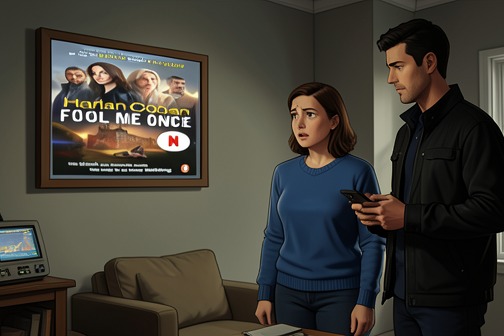
[Maya Stern](entity:character-recall-character-maya-stern-a52f3b60bd3f)’s apparent sighting of [Joe Burkett](entity:character-recall-character-joe-burkett-ff87ad74dc0f) on a nanny-camera recording is a pivotal collision between grief, visual evidence, and deliberate deception. A digital picture frame that [Eileen Finn](entity:character-recall-character-eileen-finn-eee1b1baafd6) gives Maya as a nanny camera appears to show Joe playing with [Lily](entity:character-recall-character-lily-96089ba009e2) after his death. The image is convincing enough to unsettle Maya’s understanding of what she has seen, but its accuracy in small details makes it harder to dismiss as an old recording; later, [Hector](entity:character-recall-character-hector-45b791ca99c8) and [Isabella](entity:character-recall-character-isabella-7de94f8c52ed) disclose that the footage was staged and altered before being placed in the frame.
## The camera and the apparent sighting
[Eileen](entity:character-recall-character-eileen-7f2a83f06e48) gives Maya a nanny camera disguised as a digital picture frame, presenting an ordinary household object as a means of watching over Lily. Maya later views its footage on her laptop by inserting an SD card. The apparent sighting is not a vague impression: the recording shows Joe playing with Lily on the couch. For Maya, who understands Joe to be dead, the scene gives the familiar domestic image an impossible meaning. The camera does not merely record family life; it seems to contradict the central fact around which her life has been reorganized.
When Maya recounts the incident to [Ricky Wu](entity:character-recall-character-ricky-wu-7c16335d19a9), he asks whether the footage might be an old recording made before Joe’s death. Maya rejects that possibility on specific grounds. Lily is wearing exactly what she wore on the day of the sighting, and the image comes from the precise angle of the camera on the shelf, aimed at the couch. The recording is therefore neither simply an old family clip nor an unlocated image inserted without regard to the room. Its apparent contemporaneity is what gives it force—and, as the later explanation shows, what required someone to reproduce the scene deliberately.
## Testing what Maya saw
The footage becomes a question of evidence as well as perception. During a conversation about how she watches the camera, Maya explains that she uses a laptop and an SD card. Isabella took that card after pepper-spraying Maya. Later, when Maya tries to show [Roger Kierce](entity:character-recall-character-roger-kierce-a9ce6f9cf78c) the recording, she opens the laptop and clicks play, but nothing appears: the SD card is missing. The absence prevents her from presenting the image when she wants another person to see it and leaves her account harder to verify in that moment.
Maya also discusses the sighting with Ricky Wu, who knows about her post-traumatic stress disorder. He distinguishes the auditory flashbacks she experiences from the visual claim at issue. Wu says that 30 to 40 percent of combat veterans with PTSD report auditory hallucinations, and explains that Maya’s symptoms have been exclusively auditory. He does not claim to prove that she saw Joe, but he does not accept PTSD as an adequate explanation for imagining her husband in a silent video. His response keeps two propositions separate: Maya’s diagnosis is real, but it does not, by itself, establish that this particular visual experience was a hallucination.
That distinction matters because the recording is not merely a private vision. Maya describes an external image with identifiable clothing, camera placement, and a specific moment with Lily. Yet those details cannot authenticate the footage: they can be accurate because somebody arranged them to be accurate. The episode makes the apparent opposition between a genuine recording and a fabricated one less secure. A convincing image can preserve the right angle and the right clothes while still presenting an event that did not happen.
## The fabrication revealed
The later account from Hector and Isabella resolves the central mystery. Hector says that he dressed up as Joe and that they let the nanny camera record him. He took the SD card back to [Farnwood](entity:location-recall-location-farnwood-12802aa31c83), where the family had a CGI and Photoshop specialist alter the footage. About an hour later, he returned to the house with the card, and Isabella put it into the picture frame. What Maya saw was not an unaltered record of Joe returning to the family home, but a staged performance processed to make Joe appear in the camera’s view.
Isabella explains how she recognized that Maya had a nanny camera: the day after the funeral, Maya had a new digital frame already loaded with family photographs, despite not displaying pictures of Lily or hanging up her artwork. That observation connects the frame’s inconspicuous appearance to the scheme’s practical opportunity. The camera is useful precisely because it looks like a domestic ornament, while the SD card provides a portable route for recording, editing, and replacing the footage. The deception depends not on a supernatural return, but on people controlling what the device records and what Maya is allowed to see.
The camera’s vulnerability also has a broader personal context. Eileen later discovers that someone has obtained photographs taken inside her house and suspects her abusive husband, Robby. She had assumed that cameras using SD cards were not connected to the web and had not realized they could be hacked. Her experience does not establish that the same method produced Maya’s footage; instead, it reinforces the story’s distinction between a device that seems private and a recording system whose access and security its user may not understand.
## Death, surveillance, and the image’s afterlife
The deception draws power from the family’s unresolved relationship to death and proof. [Caroline Burkett](entity:character-recall-character-caroline-burkett-8ecd81c1903e) tells Maya that she never saw Andrew’s body after his death, which left her unable fully to accept that he was gone. Remembering that experience, Maya says she begged to see Joe’s body so she could accept his death, but was not allowed to see it either. The fabricated image exploits the emotional space opened by that absence: a picture of Joe with Lily offers the return that the missing body cannot substantiate, while giving Maya no reliable proof that he survived.
The nanny camera’s role does not end with the false sighting. Later, a camera Maya places above the fireplace at Farnwood is used to livestream what happens in the Burkett house to the public. [Shane](entity:character-recall-character-shane-05621ac800e8) recalls that the broadcast helps bring attention to [Corey Rudzinski](entity:character-recall-character-corey-rudzinski-b9d8ede4aa54)’s site and encourages people who had been afraid to speak about abuse or corruption to come forward. The same kind of device that first makes private family footage available for manipulation becomes a means of public exposure. Across these episodes, the camera is never a neutral witness: its significance depends on who controls the recording, the storage card, the editing, and the audience.
Maya’s sighting therefore changes meaning twice. At first, it seems to challenge the certainty of Joe’s death; in retrospect, it exposes a carefully constructed deception. Its lasting force comes from the narrow gap between what an image can show and what it can prove: exact details make the footage persuasive, but only the later account of its production explains how those details were made to fit.
Event 15
Disappearance of Tom Douglass
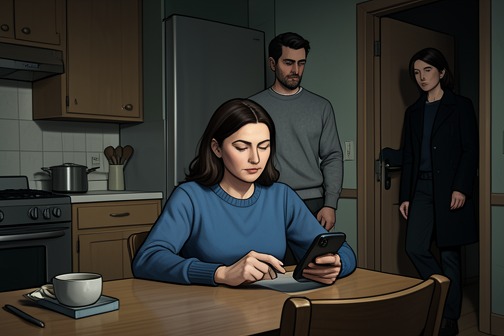
[Tom Douglass’s disappearance](entity:state-recall-state-tom-douglass-3e44b6993fd8) becomes a turning point in [Maya Stern](entity:character-recall-character-maya-stern-a52f3b60bd3f)’s investigation: a man who might ordinarily be treated as absent on a fishing trip is now missing amid questions about Burkett family payments and the deaths of people connected to that inquiry. The facts available at first are incomplete. His wife does not know where he is, the police have not accessed his work files, and Maya and [Corey Rudzinski](entity:character-recall-character-corey-rudzinski-b9d8ede4aa54) must decide how to search without mistaking suspicion for proof.
## Background and Reported Absence
Maya learns of Tom’s disappearance when she returns to speak with [Mrs. Douglass](entity:character-recall-character-mrs-douglass-0c3263794d73). Asked where her husband is, Mrs. Douglass says she does not know, then explains why she called Maya back: Tom has been missing for three weeks. The exchange makes the absence concrete, but it does not establish how or why he left, or whether anyone took him.
Mrs. Douglass has already reported him missing to the police. Tom is fifty-seven, and, in the absence of suspected foul play, the police have little they can do. Her account gives the missing-person report an ordinary explanation that also makes it difficult to act on: Tom loves fishing and sometimes goes away for weeks. She says he would not usually do so without telling her, but the length and familiar pattern of his trips have helped the police regard the absence as insufficient grounds for a fuller inquiry.
The uncertainty is therefore procedural as well as personal. The police have entered Tom’s name into their system, but a detective has told Mrs. Douglass that investigators cannot examine Tom’s work files without a court order. His professional records might matter to Maya’s investigation, yet the missing-person report alone has not opened them to scrutiny. The barrier does not prove that the files contain anything incriminating; it marks a gap between what Maya suspects and what authorities can presently investigate.
## Maya and Corey Turn to the Search
Maya brings the news to Corey Rudzinski: Tom has been missing for three weeks. The bluntness of her reply when Corey asks where he is underscores the essential limit of the information—neither she nor Mrs. Douglass can locate him. Maya then gives Corey the surrounding context, including what she has learned about [Andrew Burkett](entity:character-recall-character-andrew-burkett-608b4457561b)’s death being a suicide and what she already knew from [Joe Burkett](entity:character-recall-character-joe-burkett-ff87ad74dc0f).
Corey assembles the circumstances into a possible pattern. In his account, [Claire Walker](entity:character-recall-character-claire-walker-e40954ccca49)’s investigation leads her to Burkett payments to Tom, after which [Claire](entity:character-recall-character-claire-a8a181f2052b) and Joe are killed and Tom goes missing. His sequence is slightly wrong: the order Maya knows is Claire, Tom, Joe. She does not correct him, and the difference leaves a small but telling distinction between a working theory and a precise chronology. The deaths and absence may invite a connected explanation, but Corey’s compressed timeline is not itself evidence that the events share a cause.
The suspicion gains force from the payment question, not from any confirmed account of Tom’s last movements. Corey’s formulation links Claire’s investigation to the payments and places Tom’s disappearance within the same troubling chain. Maya has already encountered questions about the scale and duration of those payments. Still, the available facts do not establish what Tom knew, whether he was in danger, or whether the payments explain his absence. The case remains an inference built from proximity and timing.
## Expanding the Search
Maya asks Corey to use his organization’s sources to investigate Tom’s life comprehensively. Corey says they have already looked into Tom’s work for clues, but Maya now wants a broader search: credit-card statements, ATM activity, the date of his last transaction, his habits, and places he might go. The request shifts the effort from interpreting the payments alone to reconstructing a missing person’s routine through records and behavior.
Corey agrees that they can do it. His earlier work means the search is not beginning from nothing, but Maya’s request changes its scope: transaction history and habits could help establish when Tom was last active and where he might have gone. The work is still prospective in this exchange. No last transaction, destination, or discovery is reported here, so the proposed search should not be confused with a result.
## Significance and Uncertainty
Tom’s disappearance unsettles the distinction between a routine absence and a possible crime. Fishing trips lasting weeks give the police a reason not to assume foul play; Mrs. Douglass’s conviction that he would normally tell her gives Maya reason not to dismiss the absence as routine. Neither account resolves the contradiction. The three-week duration and the limits on access to his work files leave the case suspended between ordinary explanation and serious suspicion.
Its narrative importance lies in how the absence reorganizes Maya and Corey’s investigation. A suspected trail of payments had already connected Tom to questions surrounding Claire’s inquiry; his disappearance makes locating him urgent and raises the possibility that the financial trail matters to more than one death. Yet the story preserves the distinction between a pattern worth pursuing and a proven conspiracy. At this stage, Tom is missing, his whereabouts are unknown, and the search has been enlarged—but the available account does not disclose what happened to him.
Event 16
Theo Mora's hazing-related death
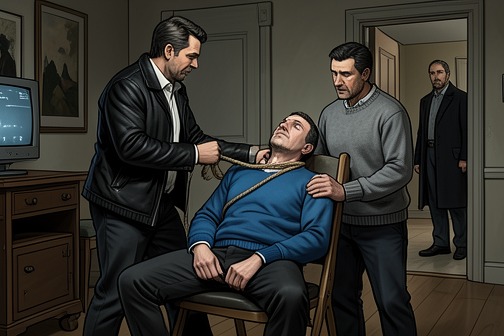
[Theo Mora's hazing-related death](entity:event-recall-event-theo-mora-hazing-44d0fa55b7d1) exposes the lethal turn beneath an initiation the participants had treated as ordinary school mischief. In [Christopher Swain](entity:character-recall-character-christopher-swain-6afdf5d2645a)'s belated account, [Joe Burkett](entity:character-recall-character-joe-burkett-ff87ad74dc0f) leads the group, [Andrew Burkett](entity:character-recall-character-andrew-burkett-608b4457561b) and Christopher follow, and a joke becomes a fatal assault when Joe substitutes grain alcohol for beer while Theo is restrained and forced to drink.
## The Prank and the Group's Roles
Christopher recalls that Joe presented the plan as a prank, though Christopher cannot say whether he believed that explanation. He describes himself as weak and as Joe's follower; Andrew, too, was a follower. The group rationalized the hazing as familiar at schools like [Franklin Biddle Academy](entity:location-recall-location-franklin-biddle-acad-a0914b5bdd05) and assumed that a little of it could do no harm. That assumption helped turn collective participation into an excuse not to question what they were doing.
The group went to Theo's room: Christopher and Joe arrived, while Andrew was already there. They jumped on Theo, carried him downstairs, and took him into a room where they put him in a chair. Christopher remembers leaving one knot loose. Joe noticed and tightened it, a small but consequential action that made Theo more securely restrained before the drinking began.
## From Ritual to Fatal Harm
Theo initially seemed to accept the scene as part of the hazing. Christopher remembers him smiling and pretending to call for help as the group tied him up. That apparent participation shaped the boys' sense that the event remained a game, but the mood changed when Joe put a drinking funnel into Theo's mouth. Two other participants, Larry Raia and Neil Kornfeld, were also present, and the group laughed and chanted for Theo to drink as Andrew poured beer through the funnel.
The decisive reversal came when Joe replaced the beer with grain alcohol. Christopher remembers Andrew telling Joe to stop, a brief objection that came after the group had already restrained Theo and begun forcing liquid into him. Theo's leg suddenly thrashed as if he were having a seizure. Christopher's recollection breaks off around that moment, marking the point at which the supposed prank could no longer be mistaken for harmless play; the incident ended in Theo's death.
## The Recollection and Its Aftermath
The event reaches the reader through Christopher's later testimony to [Maya Stern](entity:character-recall-character-maya-stern-a52f3b60bd3f). As he recounts it, his attention shifts between remembered details—the loose knot, the funnel, the change in Theo's eyes, and Andrew's warning—and the difficulty of believing that the night happened as he describes it. His account does not present the hazing as a single, deliberate plan to kill Theo: it describes a group that followed Joe's lead, kept laughing as the danger escalated, and crossed into lethal harm when Joe changed what Theo was made to drink.
Christopher says he had never told the story before the day before speaking with Maya. After her email, he disclosed some of it to his doctor, who thought it might help for him to talk with Maya. He explains that he was afraid Joe would kill him if he spoke—not only at the time, but even now. As he cries, Maya feels both the impulse to comfort him and the impulse to strike him; she does neither, instead sitting and waiting. The silence that followed the hazing thus becomes part of the event's continuing aftermath: Christopher's fear preserved the secret, while his belated account makes the group's actions and Joe's substitution of grain alcohol explicit.
Event 17
Andrew Burkett's fatal fall from the yacht
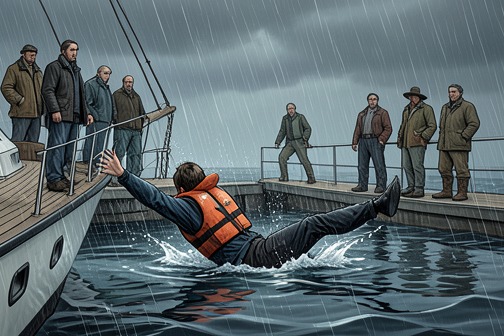
[Andrew Burkett](entity:character-recall-character-andrew-burkett-608b4457561b)’s fatal fall from a yacht is the event that converts a family’s long-held account of an accident into a suspected murder. Years later, Maya’s questions uncover the last hours before Andrew went overboard: guilt had driven him to plead with his friends to confess their part in [Theo Mora](entity:character-recall-character-theo-mora-d5bf68388ed0)’s death, and Joe followed him onto the upper deck. The account never supplies a direct confession to what happened there, but the gap between Joe’s explanation and the delayed alarm makes that silence decisive.
## Causes and Background
Six weeks after Theo Mora’s death, Andrew and his friends were together again aboard a yacht heading for Bermuda. The reunion brought the group back into the presence of the death they had concealed. Andrew had been in therapy, but, as Maya reconstructs it, guilt continued to consume him. He had reached a point where keeping the secret to himself seemed unbearable.
Maya initially asks [Christopher Swain](entity:character-recall-character-christopher-swain-6afdf5d2645a) whether Andrew threatened the others. Christopher corrects that account: Andrew pleaded with them to come forward. He could not sleep or eat, looked terrible, and told them they had to admit what they had done. Christopher was so drunk that he could barely understand Andrew. His condition limits what he can say about the conversation, but his testimony establishes the immediate pressure on Andrew and the group: the secret was at risk of being exposed by one of its own participants.
## The Last Hours on the Yacht
After pleading with the group, Andrew went outside to the upper deck, apparently to get away from the others. A few minutes later, Joe followed him. Christopher’s account ends there. He does not describe seeing Andrew fall, and he never reported the conversation or Joe’s presence to anyone. His silence left the central encounter on deck without a witness willing to explain it, while preserving the others’ secret about Theo.
The circumstances acquire sharper meaning when Maya confronts the Burketts with Christopher’s account. Judith’s explanation is that Joe saw Andrew jump. Maya then places that claim against the timeline: Joe and Andrew went up on deck at one in the morning, but Andrew was not reported missing until the following morning. If Joe had witnessed his brother’s accidental jump, Maya reasons, he would have raised the alarm at once. The delay does not itself show exactly what happened on deck, but it makes Joe’s account difficult to accept and shifts the fall from apparent accident toward deliberate concealment.
## Family Grief and the Missing Body
The uncertainty around Andrew’s death has never been only a matter of evidence. Caroline tells Maya that she was young when Andrew died and was not allowed to see his body; the funeral was closed-casket. Although she knows he died in an accident, she says that she has never been able fully to accept it. She still dreams of him alive by the soccer net, smiling and making saves, and sometimes imagines that he survived the fall and swam away to an island. Without seeing his body, the possibility of his return could persist beside her knowledge of his death.
Caroline connects that experience to Maya’s request to see Joe’s body. Having been denied the chance to confirm Andrew’s death for herself, she begged to see Joe, even if the sight would be distressing, because she needed to accept that he was gone. She, too, was refused. The parallel makes the body more than proof in an investigation: for those left behind, physical confirmation can mark the boundary between hope and loss. Yet in Andrew’s case, even a body would not necessarily have answered the deeper question of how he fell or what Joe did after following him onto the deck.
## Consequences and Significance
Maya’s disclosure of Christopher’s testimony breaks through Judith’s defense of Joe. As Maya describes Andrew’s plea to expose what the group did to Theo and Joe’s decision to follow him, Caroline begins crying and Neil looks to his mother for help. Then Maya points out the delayed report. Judith’s eyes widen, and she drops to her knees. The reaction suggests that the timing has forced her to recognize what she had resisted acknowledging: Joe’s story about witnessing an accident does not fit the evidence she has just heard.
Christopher’s silence and the family’s earlier account allowed Andrew’s death to remain publicly legible as an accident while its circumstances stayed unresolved. The revelation links the yacht to the concealed death of Theo: Andrew’s guilt threatened to expose the original wrongdoing, and the final private meeting with Joe became the point at which that secret—and Andrew’s fate—converged. The novel does not stage the fall as a witnessed scene; it reconstructs it through testimony, remembered explanations, and a suspicious delay. That form keeps the precise act offstage while making its consequences increasingly difficult to deny.
The loss also reverberates beyond the family’s investigation. Near the novel’s close, [Shane](entity:character-recall-character-shane-05621ac800e8) sees [Lily](entity:character-recall-character-lily-96089ba009e2) smile and recognizes Maya in her expression; the child does not remember her mother, but the resemblance sustains Shane’s connection to her. At the end, the naming of a new child Maya leads him to question whether death is as final as he once believed. These later reflections do not resolve Andrew’s death. Instead, they extend the story’s concern with how the dead remain present to the living—in memory, in family resemblance, and in the unanswered accounts that outlast them.
Event 18
Al Qa'im helicopter attack
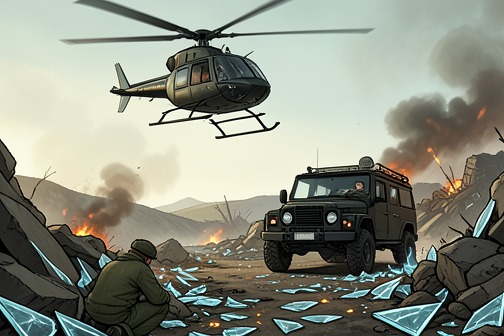
The [Al Qa'im helicopter attack](entity:event-recall-event-al-qa-im-8d78568c318e) is the combat decision at the center of [Maya Stern](entity:character-recall-character-maya-stern-a52f3b60bd3f)’s later reckoning with her past: she fired on a black SUV to protect pinned soldiers, despite an order to hold fire and a warning that the vehicle might carry civilians. Initially remembered as a rescue that went right, the strike becomes, through Maya’s confession to [Shane](entity:character-recall-character-shane-05621ac800e8), a disclosure of deliberate disobedience and the civilian deaths she accepts as its cost.
## Mission and Operational Uncertainty
The mission began with an ambush near [Al Qa'im](entity:location-recall-location-al-qa-im-f3e50c8e76a4), not far from the Syrian-Iraqi border. Four soldiers, including three Maya knew and loved, had been killed; two others were still alive, pinned down under enemy fire. A black SUV was moving toward the survivors. Maya and Shane, flying at full speed in a Boeing MH-6 Little Bird light helicopter gunship, heard the soldiers pleading for help. The voices sounded terribly young to Maya, as she imagined the four who had already died might have sounded just the same.
The crew acquired sight of the SUV but waited for confirmation before engaging. Communication from Joint Operations Command at Al Asad kept breaking up, while the survivors’ calls for help came through clearly. That contrast intensified the pressure: Maya and Shane could hear the endangered soldiers, yet they did not have a clear, reliable exchange with command. They cursed into the radio and demanded a response. Before any authorization arrived, the two soldiers screamed.
The mission’s apparent clarity concealed a consequential uncertainty about the target. Shane later recalled that command wanted to ensure the people in the SUV were not civilians. Maya’s fuller account specifies that JOC had ordered them to hold off: officials believed at least one occupant might be a civilian, possibly underage, and assessed only an approximately fifty-fifty chance that the occupants were enemy fighters. The order was not an authorization to strike; it was a warning to wait.
## The Strike and Immediate Rescue
Maya’s helicopter fired an AGM-114 Hellfire Missile at the black SUV. The vehicle exploded high into the air, and infantry moved in to rescue the two pinned soldiers. Both had been hit, but both survived. In the initial telling, the destruction of the approaching vehicle and the rescue that followed made the decision seem righteous. The operation’s immediate outcome was real: two soldiers who had been pleading for help lived.
That outcome, however, did not settle whether the strike was authorized or who was inside the SUV. Maya later corrects Shane when he speaks as if they had waited until confirmation arrived. They never received the go-ahead. Instead, Maya says, JOC radioed them to hold off because civilians might be among the occupants. The gap between rescuing the soldiers and obeying the order is the event’s decisive moral and narrative turn: the rescue does not erase the choice made to achieve it.
## The Disobedience Revealed
Maya tells Shane that she turned his signal off. When he questions what she means, she explains that JOC had withheld permission and that the warning concerned possible civilians. She also says she relayed the information to him. The conversation exposes how much Shane’s understanding of the operation differed from hers: he had believed they followed protocol and acted after confirmation, while Maya knew there had been no authorization to fire.
She admits that she acted because she cared about the soldiers under threat and did not care about the civilians who might die. She describes the possibility of civilian deaths as collateral damage she was willing to accept rather than lose another of her own. Her account does not present the strike as an accidental misunderstanding or a decision forced by a received order. She made a choice, knowing the risk to people in the SUV, and places responsibility for it on herself.
The attack’s emotional aftermath is equally specific. Maya rejects Shane’s assumption that her flashbacks come from guilt over the dead civilians. She says the deaths do not haunt her; what remains with her is the absence of guilt and her certainty that, given the same circumstances, she would do the same thing again. The confession turns trauma from a simple sign of regret into evidence of a conflict that has not been resolved: Maya recognizes the gravity of her choice without claiming she would reverse it.
## The Recording and Its Consequences
The combat video released by [Corey Rudzinski](entity:character-recall-character-corey-rudzinski-b9d8ede4aa54) becomes the public route back to the mission and the beginning of Maya’s tailspin. Years later, she thinks about how directly the release led to the deaths of [Claire](entity:character-recall-character-claire-a8a181f2052b) and Joe. She had gone to Corey’s website to retrieve the old video even though many versions were available on YouTube; returning to its original source felt right to her. The recording’s circulation thus connects the distant attack to the present crisis in her family and private life.
Maya clarifies to Shane that the evidence Corey held against her was not merely that the crew sounded celebratory after destroying the target. It was the radio call in which she was told civilians might be in the SUV. That distinction moves the controversy from the appearance of the crew’s reaction to the substance of Maya’s decision: the decisive fact was that she heard the warning and fired anyway. The attack therefore persists in two forms, as a rescue remembered for the soldiers who survived and as a recorded, morally compromising act whose concealed circumstances eventually become speakable. Her final admission leaves its central consequence unresolved: the survivors were saved, but Maya remains committed to the choice that endangered civilians.
Event 19
Murder of Claire Burkett by Joe
The murder of [Claire Walker](entity:character-recall-character-claire-walker-e40954ccca49) by [Joe Burkett](entity:character-recall-character-joe-burkett-ff87ad74dc0f) is the buried crime that transforms [Maya Stern](entity:character-recall-character-maya-stern-a52f3b60bd3f)’s grief into a confrontation with the Burkett family’s power. [Claire](entity:character-recall-character-claire-a8a181f2052b) had tried to expose information that threatened the family; Joe killed her, and [Judith Burkett](entity:character-recall-character-judith-burkett-f47ac3a24d33) knew what he had done. The eventual account does more than identify a murderer: it reveals how the family recasts violence as self-defense and uses secrecy to keep both its fortune and its authority intact.
## Causes and the Burkett family’s account
Claire’s conflict with the family centered on information she had taken and her attempt to bring down the Burkett name and fortune. Judith later describes Claire as having stolen from them and tried to destroy the whole family. In her telling, Joe first tried to reason with Claire and then panicked when she would not return the information. That account is not a denial of the killing. It is Judith’s effort to make the family’s threatened position the measure of what Joe did.
Maya gives the same confrontation a different moral meaning. She says Joe murdered her sister and that Judith knew; Judith responds by treating Claire as an enemy who had to be fought without mercy. The clash exposes the family’s governing logic: a threat to its wealth and reputation is portrayed as an attack that licenses retaliation. Judith’s explanation supplies a motive, but it also makes clear that she is defending Joe’s conduct rather than grieving Claire as a victim.
## The killing and Maya’s recognition
The narrative establishes Joe as Claire’s killer through Maya’s recognition and the family confrontation. Maya knows that her own gun killed her sister, even before she takes it to the shooting range and asks [Shane](entity:character-recall-character-shane-05621ac800e8) to compare its firing with the .38 found in Claire’s skull. That knowledge is emotionally devastating: the weapon is not an abstract clue but Maya’s own property, tying the murder to the private spaces and trust of her family.
Maya nevertheless considers the possibility that her conclusion is wrong. Someone could have broken into the safe, used her gun, and returned it; perhaps Joe was not the killer. Her uncertainty is not simply denial: it leads her to examine how the weapons were stored and to set up a test. She exchanges two Smith & Wesson 686 revolvers, moving the one Joe had taken from the hidden compartment for out-of-state purchases in place of the one registered in [New Jersey](entity:location-recall-location-new-jersey-25586b9a9d1c) and kept in plain view. She leaves her other guns unloaded and without ammunition. The concealed weapon becomes a way to distinguish suspicion from what the family has actually done.
The murder’s physical evidence also enters the wider investigation. [Roger Kierce](entity:character-recall-character-roger-kierce-a9ce6f9cf78c) tells Maya that the .38s recovered from Joe’s body were run through ballistics to check for matches in the police database, and his nervous scratching precedes the confirmation that a match was found. That exchange does not by itself settle every question about Claire’s death, but it shows how the guns and the two deaths become linked by forensic inquiry as well as by Maya’s suspicions.
## Judith’s knowledge and the deception around Maya
Judith’s knowledge makes the murder a family secret rather than a crime committed beyond the family’s awareness. When Maya states that Joe killed Claire, Judith does not deny the underlying accusation; instead, she explains why she believed Claire deserved to be treated as an enemy. Her response confirms the depth of her loyalty to the family’s survival and her willingness to subordinate Claire’s suffering to it.
That loyalty also shapes Judith’s later psychological pressure on Maya. Judith admits that she arranged the nanny-camera stunt to unsettle a woman she believed had killed Joe, while knowing there was no way to prove it. The fabricated appearance of Joe, the missing clothes and phone calls, and [Caroline Burkett](entity:character-recall-character-caroline-burkett-8ecd81c1903e)’s false claims that her brothers were alive and that Roger Kierce was on the family payroll were presented as parts of a deliberate experiment. Judith expected Maya to question what she had seen, investigate, and perhaps make a mistake that could expose what she knew. The murder thus becomes the hidden premise of the manipulation: Judith understands that Claire’s death gives Maya a motive, and uses that knowledge to try to control her.
## Secrecy, complicity, and the cost of withholding
The murder also gives force to Maya’s conflict with [Corey Rudzinski](entity:character-recall-character-corey-rudzinski-b9d8ede4aa54) and his organization. Corey acknowledges that he had held back audio from Maya’s combat tape, partly to increase the eventual impact and exposure for his cause, and says he did so after Claire asked him not to release it. Later, when Maya asks for help finding Claire’s killer, Corey invokes the organization’s commitment to keeping sources confidential—even though Claire has been murdered. Maya argues that protecting the organization in this way repeats the secrecy practiced by the governments and businesses Corey condemns, and accuses him of helping Claire’s killer go free.
The conflict does not establish that Corey participated in Claire’s murder or knew who committed it. Instead, it shows how competing duties to a source, an organization, and a victim can leave the truth obstructed. Claire had asked for restraint about the audio; Corey’s commitment to confidentiality persists after her death. Maya sees that persistence not as neutral protection but as a choice with consequences for the search for accountability.
## Motive and narrative consequence
Revealing Joe as Claire’s killer clarifies why Maya’s own actions and Judith’s suspicions converge. Judith understands that Maya had a reason to kill Joe, while Maya’s discovery gives her a reason to confront the family and test the evidence. The murder is therefore both an earlier act of violence and the motive behind later scrutiny, deception, and accusation.
Its significance rests in the contrast between evidence and the stories built around it. A .38 bullet, a weapon taken from a hidden compartment, and Maya’s deliberate exchange of revolvers point toward a concrete crime; Judith’s account attempts to redescribe that crime as a necessary defense of the family. The eventual confrontation refuses that justification. Claire’s attempt to expose the Burketts may have threatened their name and fortune, but Judith’s defense reveals that the family’s idea of protection depends on making the person who challenges it seem like the aggressor.
Event 20
Maya shoots Joe Burkett in Central Park
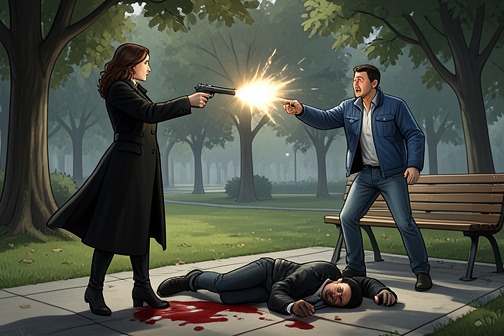
[Maya shoots Joe Burkett in Central Park](entity:event-recall-event-joe-burkett-ca318e94af65) after arranging a meeting designed to make him reveal why he had killed [Claire](entity:character-recall-character-claire-a8a181f2052b). The encounter turns the evidence she has assembled into a test of Joe’s guilt, then into a carefully staged killing: she shoots him with the same kind of weapon connected to Claire’s murder and leaves the scene looking like an unsolved robbery. Maya regards the result as a form of justice and a way to protect herself and her daughter, until the nanny-camera video unsettles the resolution she has constructed.
## The Meeting in [Central Park](entity:location-recall-location-central-park-552b924273db)
Maya, not Joe, called that night. She had searched through Joe’s belongings and deliberately left clues so he would know she was onto him and might react. Her aim was to get enough information to make him explain Claire’s death. She told him she had proof, then directed him to meet her in Central Park.
She arrived early and watched the area around [Bethesda Fountain](entity:location-recall-location-bethesda-fountain-c43ce0c97d70). Two men, Emilio Rodrigo and Fred Katen, passed by; from Rodrigo’s movements, Maya recognized that he was carrying a weapon. She saw them as potential fall guys, people unlikely to be convicted, and built that possibility into her plan. When Joe arrived, she asked why he had killed Claire. He challenged her claim to have proof, and Maya said she would find it and make his life hell. The exchange gave Joe the opportunity to deny her accusation—and brought them to the moment when his response would decide what happened next.
## The Gun That Did Not Fire
Joe drew the loaded Smith & Wesson 686 he had found in the safe’s hidden compartment and aimed it at the center of Maya’s chest. The sight of the gun swept away her attempts to force an explanation out of him. She had suspected Joe, yet still hoped that the accusation might be mistaken—that the man she had loved and the father of her child could not be the killer who had tortured and murdered her sister. In the memory she later revisits, she thinks Joe was smiling, though she admits the darkness may have made his expression impossible to see clearly; her attention was fixed on the weapon.
Joe pulled the trigger, but the gun did not fire. He tried again, then again. The failed shots reverse the immediate balance of the encounter: Joe has aimed a weapon at Maya, but the moment he intended to control does not end with her death. The remembered scene preserves both her fear and her uncertainty about what she saw, distinguishing the gun’s unmistakable presence from her less reliable impression of his face.
Later, Joe insists that Maya will never prove he killed Claire. She answers, “You’re right.” Maya then draws her other Smith & Wesson—the same gun Joe had used to kill Claire—and shoots him three times. The first two shots are deliberate misses: as an expert markswoman, Maya knows that a single fatal shot would look too obvious beside the two men she has noticed nearby, one of whom carried a weapon. The measured sequence turns the confrontation into a constructed crime scene, making the shooting serve both as punishment and as an attempt to disguise who carried it out.
## Staging the Aftermath
After shooting Joe, Maya made the scene support the explanation she had prepared. She had worn a trench coat and gloves bought with cash at a Salvation Army store, intending to keep any gunpowder residue on clothing that could not be traced to her. She pulled them off and threw them over a wall into a bin on Fifth Avenue. Then she bent over Joe as he died, deliberately getting his blood on her shirt, put both guns in her handbag, and stumbled back toward Bethesda Fountain. The gestures were practical as well as theatrical: she was constructing the appearance of a victim emerging from a robbery, not simply leaving the place where she had killed her husband.
Maya expected ballistics to complicate the investigation. The same gun had killed Claire and Joe, while Maya had a solid alibi for Claire’s murder because she was serving overseas; she reasoned that police therefore could not plausibly identify her as the killer in either case. She also intended to implicate Emilio Rodrigo and Fred Katen, whom she expected to escape conviction. One of them had been armed, and Maya knew that her account of ski masks would make charges difficult to sustain. She disliked the harm the investigation might cause them, but judged it negligible beside what she had done before. In her calculation, the resulting case would be an unsolvable mess: Claire’s murderer had been punished, and Maya and her daughter would be safe. She understood this as justice of sorts, not as a clean or lawful resolution.
The later confrontation at the Burkett home makes the distinction explicit. Judith says the killing was an execution, not self-defense, because Maya could have brought Joe in. Maya agrees that she chose to murder him. She explains that she could not allow Judith to protect him again, and says that everything will now come out. Judith warns that disclosure could send Maya to prison for life. The exchange strips away the cover story Maya built in Central Park: she acted deliberately, and her protection of [Lily](entity:character-recall-character-lily-96089ba009e2) depended on concealment as much as on punishment. The nanny-camera video had already changed the meaning of the apparent ending, reopening a danger Maya thought the staged crime had settled.
## The Apparent Ending Unravels
The account returns to [Maya Stern](entity:character-recall-character-maya-stern-a52f3b60bd3f) seated in the dark foyer, where the supposed resolution of the Central Park shooting has already been unsettled by the nanny-camera video. She stays in her chair as a car pulls up and the front door opens. [Judith Burkett](entity:character-recall-character-judith-burkett-f47ac3a24d33) arrives with [Neil Burkett](entity:character-recall-character-neil-burkett-2896b3c62022) and [Caroline Burkett](entity:character-recall-character-caroline-burkett-8ecd81c1903e), talking about how boring the event they have attended was; the ordinary complaint contrasts with the truth Maya is about to force into the open.
The scene shifts the event’s consequence from a hidden act of punishment to a family reckoning. Maya’s plan had depended on making [Joe Burkett](entity:character-recall-character-joe-burkett-ff87ad74dc0f)’s death look like an unsolvable crime, but she now tells Judith that everything will come out. The video has made concealment unstable, and Maya no longer treats the staged explanation as a finished ending.
Event 21
Indian boy's death from counterfeit antibiotics
The death of a three-year-old boy in India turns the counterfeit-antibiotics scheme from an allegation of corporate fraud into a documented human consequence. The boy died after receiving [EAC](entity:organization-recall-organization-eac-fa3982d76387)’s version of amoxicillin for an infection; the drug did not work, and by the time his doctor changed the treatment, he had fallen into a coma.
Event 22
Fabricated nanny-camera video of Joe appearing
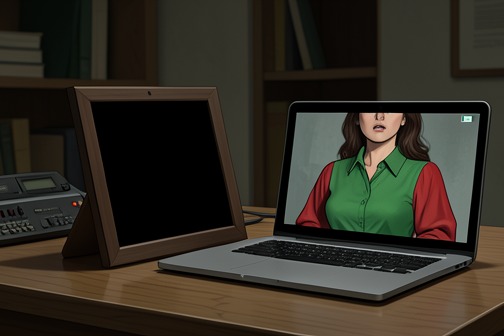
The fabricated nanny-camera video of Joe appearing turns a domestic security device into an instrument of psychological manipulation. A staged scene, an altered image, and a missing SD card make the possibility of [Joe Burkett](entity:character-recall-character-joe-burkett-ff87ad74dc0f)’s survival seem credible enough to destabilize [Maya Stern](entity:character-recall-character-maya-stern-a52f3b60bd3f), while the later confession reveals that the apparent evidence was designed to make her doubt her own judgment.
## The Frame and the First Doubts
[Eileen Finn](entity:character-recall-character-eileen-finn-eee1b1baafd6) gives Maya a digital picture frame that is actually a nanny cam. The disguise initially makes it look like an ordinary household object, but the frame becomes a source of threatening uncertainty when its camera activates and the view is blocked. Maya first thinks [Isabella](entity:character-recall-character-isabella-7de94f8c52ed) is standing in front of it; then she notices that the visible shirt is green, not the red blouse Isabella had worn the previous day. The mismatch suggests that someone else, or some other event, may be present in the footage. The image offers a tantalizing clue without yet establishing what it shows.
When Maya later turns the laptop toward [Roger Kierce](entity:character-recall-character-roger-kierce-a9ce6f9cf78c) and presses play, nothing appears. She checks the USB port and discovers that the SD card is gone. The missing card matters because the recording is not simply an unsettling image on a screen: it is a file that can be removed, withheld, and prevented from being examined by someone else. The device’s ordinary storage mechanism becomes part of the mystery, and the absence of the card leaves Maya without the material needed to demonstrate what she believes she saw.
The story also gives this kind of domestic camera a separate, unsettling context through [Eileen](entity:character-recall-character-eileen-7f2a83f06e48)’s experience. Eileen receives anonymous photographs taken inside her house, including images of her children playing and a private photograph of herself after exercising. She suspects her abusive husband, Robby, and realizes that she had wrongly assumed cameras using SD cards could not also be accessed over the internet. This is not the same as the Burkett family’s fabrication, but it establishes that a camera’s apparent local storage does not guarantee privacy. The book distinguishes two abuses of surveillance: an outsider may intrude on a household camera, while people with access to a recording can manipulate what it appears to prove.
## How the Recording Was Made
During Maya’s confrontation with Isabella and [Hector](entity:character-recall-character-hector-45b791ca99c8), Maya reconstructs the apparent sighting as a staged performance. Hector is close to Joe in height and build, she observes, and could have played him in the recording. Maya reasons that he was allowed into the house, acted out the scene, and could approach [Lily](entity:character-recall-character-lily-96089ba009e2) because Lily knew him and would go to him willingly. She also recognizes a smile on the video and suspects that Joe’s face was taken from their wedding footage. The resemblance is therefore not evidence that Joe survived: it is the result of combining a stand-in’s performance with an image of Joe.
Hector confirms the central mechanics. He dressed as Joe and performed for the nanny cam; afterward, he took the SD card back to [Farnwood](entity:location-recall-location-farnwood-12802aa31c83). The family had hired someone to create the image using CGI and Photoshop, and Hector returned roughly an hour later with the altered card for Isabella to put back in the frame. This account explains how the recording could look persuasive while having a constructed provenance: the scene was acted, the image was digitally altered, and the storage card passed from the house to Farnwood and back. The apparent video was not an unbroken record of Joe’s presence but a product assembled through performance, editing, and physical handling.
Isabella also explains how she recognized the camera. The day after Joe’s funeral, Maya already had a new digital frame loaded with family pictures, despite usually keeping few pictures of Lily or displaying Lily’s artwork. Isabella saw that conspicuous change and inferred that the frame was a nanny cam. Her observation reveals how a device’s disguise could fail to someone familiar with Maya’s habits. It also clarifies that the scheme depended not only on technical manipulation but on watching Maya closely enough to anticipate how she might use the camera.
## The Trap and Its Intended Effect
Isabella’s assigned role was to retrieve the SD card if Maya showed her the footage. If Maya presented the video, Isabella was supposed to pretend that she could not see Joe in it. Isabella says she did not know how Maya would react after seeing the recording, but her instructions were to keep Maya from showing it to other people. The scheme therefore depended on controlling both the image and the possibility of independent confirmation: the card could be removed, and a trusted witness could deny what Maya believed she had seen. Maya had also inferred that Isabella was involved when Isabella pepper-sprayed her and fled with the card.
Maya recognizes the psychological purpose of that denial. If Isabella acted as though the footage showed nothing, Maya could begin questioning her own sanity rather than treating the recording as evidence that someone was deceiving her. The intended effect was isolation: remove the file, deny the sighting, and leave Maya alone with a perception she could neither verify nor confidently dismiss. The video’s power came less from proving that Joe was alive than from forcing Maya to confront the possibility that her judgment was failing.
[Judith Burkett](entity:character-recall-character-judith-burkett-f47ac3a24d33) later acknowledges arranging the stunt. Maya says Judith told Rosa’s family that Maya had killed Joe, although there was no way to prove it, and set up the nanny-cam deception to shake the tree. Judith does not deny this. Maya explains the broader calculation: even if she did not believe Joe had survived and did not confess, she would react to the apparent evidence and start investigating. Under pressure, she might misstep and expose herself; meanwhile the family could learn what she knew. [Caroline Burkett](entity:character-recall-character-caroline-burkett-8ecd81c1903e)’s false claims about thinking her brothers were alive and about Roger Kierce being on the family payroll were part of the same psychological experiment. Together with the nanny-cam video, missing clothes, and phone calls, those lies produced a deliberately accumulating pattern of uncertainty.
## Exposure and Reversal
The eventual explanation reverses the video’s apparent meaning. Maya’s initial question is whether the image proves Joe survived; the revealed answer is that the family wanted her to believe precisely that. Her recognition that the footage could be manipulated does not erase what she saw, but it changes the question from Joe’s whereabouts to the people controlling the recording and the pressure around it. Judith’s acknowledged role supplies the missing motive, while Hector and Isabella’s explanations supply the practical steps that made the false sighting possible.
The camera’s later use at Farnwood sharpens the contrast between concealment and disclosure. Maya places a nanny cam above the fireplace, and the video from it becomes widely watched. [Shane](entity:character-recall-character-shane-05621ac800e8) later recounts that Maya arranged a live feed with help from someone who worked with [Corey Rudzinski](entity:character-recall-character-corey-rudzinski-b9d8ede4aa54), allowing the public to see what happened in the Burkett house in real time. That later broadcast is not the fabricated Joe recording: it turns the same kind of device toward a different purpose. The first use restricts access and manufactures doubt; the later one makes events visible to an audience far beyond the family.
The fabricated footage thus links surveillance to credibility and control. A digital image can appear to settle a question while concealing the staged performance, editing, and movement of the SD card behind it. In the Burkett family’s experiment, the camera does not merely watch Maya: the family uses what it records, what it withholds, and what others pretend to see in order to shape her sense of reality. The later public feed offers a pointed counter-image, replacing private manipulation with exposure, even as the story leaves the camera’s capacity to serve either purpose firmly in view.
Event 23
Abduction attempt near Solemani Recovery Center
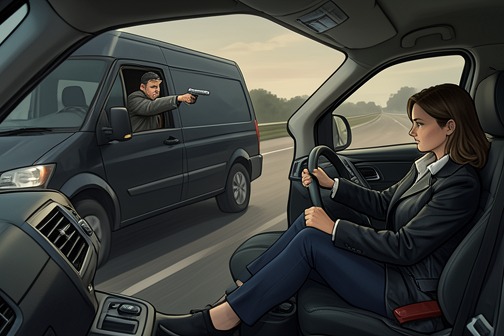
The abduction attempt near [Solemani Recovery Center](entity:location-recall-location-solemani-recovery-ce-7335be2f91ff) turns a quiet drive into a coordinated armed ambush, and then into a lethal confrontation in which Maya recognizes that the attackers’ claim about Joe is a deception. Its decisive reversal is not merely that she escapes the men: she understands that Joe did not send them, and kills one of the gunmen.
## The Ambush and Its Deception
Maya is driving down a quiet, tree-lined road while distracted by a call from [Shane](entity:character-recall-character-shane-05621ac800e8), by what [Christopher Swain](entity:character-recall-character-christopher-swain-6afdf5d2645a) has told her, and by the thoughts and emotions crowding her mind. A van approaches from the opposite direction. Because the road is narrow, she shifts her vehicle slightly to the right to let it pass, but the van abruptly swings left and cuts across her path. She brakes hard to avoid a collision, her body thrust forward against the restraint straps, and realizes that she is under attack.
The van blocks her way forward just as she reaches to put the car in reverse. A man is already at her window with a gun aimed at her head; in her peripheral vision, she sees another person at the passenger-side window. The speed with which the men appear makes the encounter seem carefully arranged: Maya reasons that they could not both have got out of the van and reached the windows so quickly, and that they may have been concealed behind a tree. The quiet road, with little traffic, leaves her isolated as the van pins her in place.
The gunman asks her to step out and come with them. Maya considers reversing or reaching for the gun in her hip holster, but either movement would expose her to the weapon already trained on her. She stays still, weighing the danger rather than acting impulsively. Then the man says, “Come on. Joe is waiting.” The words turn the ambush into a calculated deception: the side door of the van begins to slide open, but it stops halfway, and Maya cannot see who, if anyone, is inside. With her hands on the steering wheel and her heart pounding, she asks, “Joe . . . ?”
## The Reversal and Its Consequences
Maya’s suspicion resolves into a crucial conclusion: Joe did not send the men. The claim that he was waiting inside the van had offered a reason to surrender, but it was a lure, not a promise of reunion. As the first gunman goes down, Maya keeps moving rather than becoming a stationary target and turns toward the second man, raising her weapon; he ducks behind her car. The supposed rescue has become an attack she must survive on her own.
When Maya returns to the road, the first gunman is lying on his back. She keeps her gun ready in case he is pretending, but he is dead, and she recognizes that she has killed him. There is no time to dwell on the fact: another car could arrive at any moment. She searches his pockets and takes his wallet, without time to check his identification. She considers taking his phone, since she can no longer use her own, but judges that too risky. She also leaves the gun in his hand, preserving it as evidence that she acted in self-defense if events later go badly; she still has her Glock. The aftermath is therefore practical as well as lethal: the wallet may help identify the attacker, while leaving the weapon behind protects the account of how he died.
## Tactical Choice and the Cost of Survival
The scene’s tension comes from the narrowing of Maya’s choices. Reversing and reaching for her holstered weapon are both imaginable actions, but neither is realistically available while a gun is aimed at her head. The narration makes that calculation explicit before the attackers’ claim about Joe changes the situation: the promise that he is waiting offers an apparent reason to comply, while the half-open van door withholds confirmation. The trap depends on keeping those two possibilities in suspension long enough to compel her response.
Afterward, survival does not end with the gunman’s death. Maya has to consider how the scene may be judged: she takes the wallet for possible identification, rejects the phone as too risky to take, and leaves the gun in the dead man’s hand because it could support her account of self-defense. The scene thus turns a split-second fight into a problem of evidence and consequence. Her escape is immediate, but its meaning may depend on what she can later establish about the danger she faced.
## An Incomplete Resolution
The encounter settles one question but leaves the larger threat unsettled. Maya concludes that Joe did not send the gunmen, yet the men’s identities and the reason for the attack remain unknown in this episode. The second man ducks behind her car, and the wallet she takes from the dead attacker cannot yet be checked; the scene therefore ends without identifying who arranged the ambush or establishing what became of the surviving assailant. Its resolution is immediate and costly—Maya survives and one attacker is dead—but not conclusive: the false promise that Joe is waiting has been exposed, while the people behind it remain beyond reach.
Event 24
Corey releases audio from Maya's helicopter mission
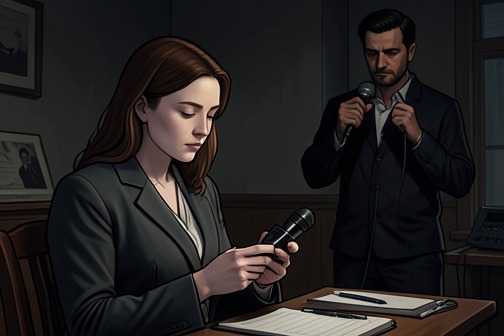
[Corey Rudzinski](entity:character-recall-character-corey-rudzinski-b9d8ede4aa54)'s release of [Maya Stern](entity:character-recall-character-maya-stern-a52f3b60bd3f)'s helicopter-mission recording is the turning point Maya later identifies as the event that set her world unraveling. The recording brings the consequences of her military mission into public view, but it also entangles Corey, [Claire Walker](entity:character-recall-character-claire-walker-e40954ccca49), and the Burkett family in an investigation whose origins Maya comes to distrust. In retrospect, the leak is not only a breach of privacy: it is the beginning of a chain that Maya connects to the deaths of [Claire](entity:character-recall-character-claire-a8a181f2052b) and [Joe Burkett](entity:character-recall-character-joe-burkett-ff87ad74dc0f).
## The Leak and Its Immediate Consequences
Maya recalls that Corey was the person who released the helicopter combat video that began her tailspin. The recording carried the consequences of her actions on the mission into her civilian life, making the military past she might otherwise have left behind an active force in the present. Maya considers how far back the chain could be traced—to her decisions on the mission, and even to her decision to join the military—but distinguishes those background causes from the event that directly set her life coming apart: the tape's release.
When Maya later asks Corey whether he felt excited when he got her helicopter video, he admits that he did. His answer confirms that the footage drew him in; it does not, by itself, resolve what he intended to do with it or how his interest in the recording intersected with Claire's investigation. For Maya, however, the admission sharpens the question of whether she has mistaken a source's disclosures for a trustworthy relationship.
## Maya Reconsiders Corey's Account
Corey had told Maya that Claire contacted him through his website and tried to stop him from releasing the audio. Maya had accepted that explanation because it made sense that Claire would approach him to prevent the recording's publication. In the car, as [Roger Kierce](entity:character-recall-character-roger-kierce-a9ce6f9cf78c) drives her home, she begins testing the account against another possibility: Corey may have contacted Claire first.
That alternative also fits the circumstances, Maya recognizes. Corey could have used the audio to manipulate or blackmail Claire into gathering information about the Burketts and [EAC](entity:organization-recall-organization-eac-fa3982d76387). This remains Maya's suspicion, not an established fact; the passage leaves the question open rather than confirming who initiated the contact. The shift nevertheless changes how she interprets her dealings with Corey. In her effort to win his trust, she may have neglected the risk of trusting someone whose publication had already helped destabilize her life.
## Recordings, Visibility, and Control
The leak belongs to a wider pattern in the novel in which recordings and images pass beyond the control of the people they depict. [Eileen Finn](entity:character-recall-character-eileen-finn-eee1b1baafd6) gives Maya a nanny camera disguised as a digital picture frame. Later, Maya sees that the camera has switched on, but its view is blocked by someone wearing green; [Isabella](entity:character-recall-character-isabella-7de94f8c52ed) had worn a red blouse the previous day, so Maya rejects her first guess that Isabella is standing in front of the lens. When Maya checks the device, its SD card is gone. Separately, [Eileen](entity:character-recall-character-eileen-7f2a83f06e48) brings Maya photographs taken inside her house and says they arrived from an anonymous email address; she believes Robby is responsible. These incidents are not shown to be connected to Corey's leak, but they echo its central vulnerability: an image can be captured, circulated, or removed without the subject controlling what happens to it.
That pattern later expands from private surveillance to public spectacle. In [Shane Tessier](entity:character-recall-character-shane-tessier-ec0bb55c953e)'s retrospective account, Maya arranges for a live feed from the nanny camera above the fireplace at [Farnwood](entity:location-recall-location-farnwood-12802aa31c83), allowing viewers around the world to watch events inside the Burkett house. Corey is already an established online presence, but the exposure brings his site enormous attention. [Shane](entity:character-recall-character-shane-05621ac800e8) notes that people who had been frightened, injured, or powerless found the courage to speak, and that corrupt governments and businesses fell. He also distinguishes this later public impact from his own grievance over the earlier publication of the mission material. The two episodes thus place the same question of visibility in sharply different settings: the recording that begins Maya's crisis and the later live transmission that makes hidden events public.
## Narrative Significance
Maya's retrospective ties the release to the deaths of Claire and Joe, describing it as what directly led to both. That judgment gives the leak its decisive place in the event chain, even as her uncertainty about Corey's role complicates any simple account of cause and responsibility. The recording exposes Maya to scrutiny; Corey's motives remain in doubt; and the investigation surrounding Claire becomes harder for Maya to separate from the possibility that it was engineered.
The later nanny-camera livestream provides an ironic counterpoint. Public exposure had first been a force that helped send Maya into a tailspin, yet she eventually uses a camera to expose events inside the Burkett home to the world. In Shane's account, that broadcast brings Corey further publicity and gives other people a platform. But its ending is not an uncomplicated celebration of transparency: the audience watches a murder happen live. The novel therefore makes visibility consequential without making it innocent; what becomes public can empower the vulnerable, invade private space, and turn violence into a spectacle.